Most beginners run into the same wall: they know digital advertising exists, they know it probably matters for their business, and they have no clear idea where to start. There are too many formats, too many platforms, and too many pricing models — and almost everything written about the topic lists all of them without helping you choose.
This guide is organized differently. It will give you the vocabulary you need, but the real goal is to help you make a decision. By the end, you should know which ad format fits your campaign goal, which platform makes sense for your audience, what pricing model aligns with your objective, and what you need to have in place before you spend a dollar.
Key Takeaways
- Matching your ad format to your campaign goal matters more than your budget size — a structural mismatch wastes money regardless of spend level
- CPC and CPM are not interchangeable; each pricing model serves a different campaign objective
- Platform choice should follow your audience, not the platform's popularity or what your competitors are using
- Conversion tracking must be set up and tested before your campaign goes live — you cannot retroactively measure what you did not configure
- Most beginner mistakes are structural and preventable, not the result of the platform failing
What Digital Advertising Is (and What It Is Not)
Digital advertising is paid media placed across digital channels — search engines, social platforms, websites, apps, video platforms, and audio services — to reach a targeted audience. You pay to get in front of people. Stop paying, and the visibility stops.
That is the most important thing to understand up front, because it separates digital advertising from everything else that gets grouped under the label of "digital marketing."
Digital marketing is the broader category. It includes paid channels like ads, but also organic strategies — SEO, content marketing, email, and social media presence — that build visibility without direct per-click or per-impression spend. A business investing in organic strategies like link building is doing digital marketing, but not digital advertising. Those two things serve different timelines and different goals.
A business running Google Ads gets traffic the day the campaign goes live. A business building organic search presence through SEO may wait months before rankings appear — but those rankings keep working after the budget runs out. Paid advertising is for immediate, targeted visibility. Organic strategies are for long-term asset building. Most businesses eventually need both. But confusing them is where beginners often start making expensive decisions.
According to the IAB's Internet Advertising Revenue Report, US digital ad revenue continues to grow year over year, reflecting how central paid digital channels have become to how businesses reach customers — but scale of adoption does not tell you whether it is right for your goal, your audience, or your budget.
| Dimension | Digital Advertising | Digital Marketing |
|---|---|---|
| Cost model | Paid per impression, click, or result | Mix of paid and unpaid |
| Primary goal | Immediate visibility and response | Long-term audience and asset building |
| Timeline | Results while spend is active | Compounds over time |
| Examples | Google Ads, Meta Ads, display campaigns | SEO, content marketing, email, social organic |
The Main Types of Digital Ads and What Each One Is Best For
There are six major ad formats in digital advertising. Each one is built for a different stage of the customer journey, a different level of audience intent, and a different kind of creative. Choosing the wrong format for your goal is one of the most common and most avoidable ways to waste ad budget.
Search Ads
Search ads appear when someone types a query into a search engine — Google or Microsoft Bing. They are text-based, and they show up because the advertiser has bid on keywords that match what the user is searching for.
This is the highest-intent format in digital advertising. The person already knows they want something and is actively looking for it. If someone searches "best CRM for small business," a search ad is well-matched to that moment. Running a display ad to the same person before they have shown any interest is a completely different proposition.
Search ads are best for conversion goals. They are typically priced on CPC — you pay when someone clicks. They run on Google Ads and Microsoft Ads.
Display Ads
Display ads are visual banners and image-based placements served across websites and apps through ad networks like the Google Display Network. The audience is not actively searching — they are browsing, reading, or watching something else when the ad appears.
This format is best for brand awareness and retargeting. It is typically priced on CPM — you pay for impressions, not clicks. For cold audiences with no prior intent signal, display ads rarely convert directly. For audiences who have already visited your site, they can be effective for staying top of mind.
Social Media Ads
Social advertising runs on platforms like Meta (Facebook and Instagram), LinkedIn, and TikTok. Targeting is based on demographics, interests, and behaviors rather than search intent. The audience is not looking for your product — they encounter your ad while scrolling.
This format is highly flexible. Depending on the creative and the offer, social ads can serve awareness, consideration, or conversion goals. The platform matters significantly here — Meta skews B2C, LinkedIn skews B2B, TikTok skews younger and entertainment-forward.
Video Ads
Video ads run as pre-roll, mid-roll, or in-feed placements on YouTube, TikTok, and streaming platforms. They are best for awareness and brand storytelling — formats where the visual medium can communicate something that a static banner or text ad cannot.
Video requires more creative investment than other formats. A weak video ad is harder to ignore than a weak banner, which means the creative quality has an outsized effect on results. Pricing is typically CPM or CPV (cost per view).
Audio Ads
Audio advertising reaches audiences during non-visual moments — commuting, working out, cooking — through podcast networks and streaming radio platforms like Spotify. It is priced on CPM and best for broad awareness. Direct response from audio is difficult to measure and typically lower than visual formats. For brands with strong audio creative and a broad audience goal, it can supplement other channels.
Native and Sponsored Content
Native ads match the look and feel of the surrounding editorial content. Sponsored articles, in-feed content on LinkedIn, and content recommendation placements are all native formats. Because they do not feel like interruptions, they tend to generate higher engagement than display formats. They are best for consideration-stage content — when the goal is to educate or build interest rather than drive an immediate click.
| Ad Format | Best For | Typical Pricing Model | Platform Examples |
|---|---|---|---|
| Search | High-intent conversion | CPC | Google Ads, Microsoft Ads |
| Display | Awareness, retargeting | CPM | Google Display Network |
| Social | Interest-based targeting, B2C/B2B | CPM or CPC | Meta, LinkedIn, TikTok |
| Video | Awareness, engagement | CPM or CPV | YouTube, TikTok, streaming |
| Audio | Reach in non-visual moments | CPM | Spotify, podcast networks |
| Native/Sponsored | Engagement without interruption | CPC or CPM | Publisher networks, LinkedIn |
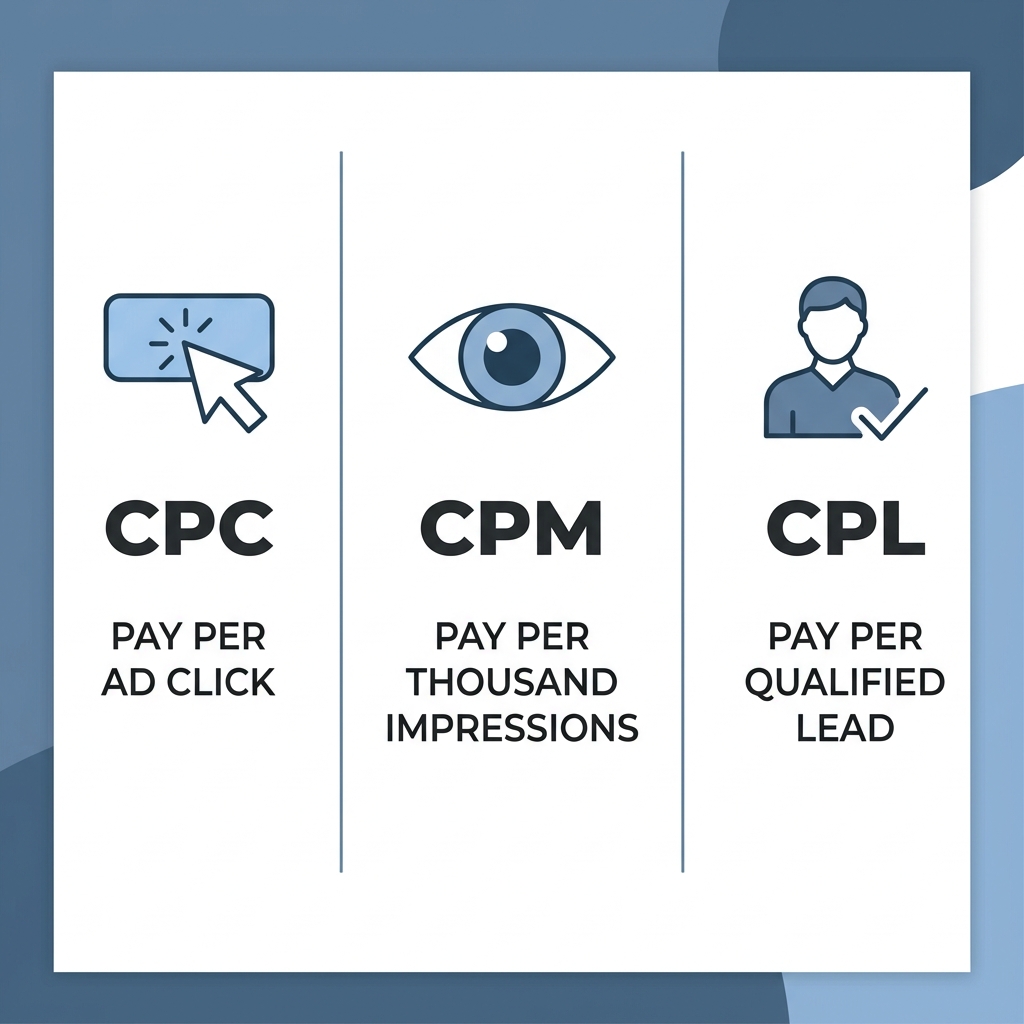
How Digital Advertising Pricing Works: CPC, CPM, and CPL
Pricing model selection is not an administrative detail. Choosing the wrong model for your campaign objective is like paying for a billboard when you need a salesperson — the spend is real, but it is solving the wrong problem.
There are three primary pricing models in digital advertising:
CPC — Cost Per Click You pay each time someone clicks your ad. This model makes sense for performance and conversion goals, where the click represents meaningful intent. You are buying action, not exposure. CPC keeps your spend tied to user engagement and is the default for search advertising. It makes less sense for awareness campaigns, where the goal is to reach as many people as possible — you could be generating thousands of impressions without generating clicks, and paying nothing for the reach you needed.
CPM — Cost Per Thousand Impressions You pay for every 1,000 times your ad is shown, regardless of whether anyone clicks. This model is built for awareness and brand-building goals. If you are launching a new product and need broad visibility, CPM buys reach efficiently. A direct-response advertiser trying to drive purchases should not be optimizing on CPM — they need clicks and conversions, not impressions.
CPL — Cost Per Lead You pay each time a qualified lead is captured — a form submission, a phone call, a sign-up. This model is common in B2B and lead generation campaigns. It aligns ad spend directly with pipeline contribution, which makes budget justification more straightforward. The tradeoff is that CPL campaigns require more setup — a clear lead capture mechanism, defined lead qualification criteria, and reliable conversion tracking.
For realistic cost context by channel, WordStream's 2025 Google Ads benchmarks provide current CPC ranges across industries — useful for setting budget expectations before you start, not guarantees of what you will pay.
If you are trying to decide whether CPC-based paid search is worth the investment for your specific situation, understanding how paid search performs for different goals is worth reading before you commit budget.
| Pricing Model | What You Pay For | Best Campaign Objective | Typical Cost Context |
|---|---|---|---|
| CPC | Each click on your ad | Conversion, lead generation, direct response | Varies widely by industry; search CPCs range from under $1 to $15+ in competitive categories |
| CPM | Every 1,000 impressions | Awareness, reach, brand building | Display and social CPMs often range from $2–$10; video CPMs vary by platform |
| CPL | Each qualified lead captured | B2B lead generation, pipeline building | Highly dependent on industry and lead definition; tied to offer value and conversion path |
How Digital Ad Targeting Works
Targeting is the primary advantage digital advertising has over traditional media. You can reach a specific person based on what they are searching for, who they are, what they have done online, or what content they are currently reading — rather than broadcasting to everyone watching a television channel.
But more targeting options do not automatically mean better results. Precision only helps when the offer and the creative match the audience at that specific stage of their decision process.
Keyword and Search Intent Targeting This is the most direct form of targeting: you reach someone at the exact moment they express a specific need in a search query. A search for "project management software for teams" signals a very specific problem and a readiness to evaluate solutions. Keyword targeting is best for high-intent capture — it is the reason search advertising is often the first channel performance marketers recommend.
Demographic and Interest-Based Targeting Platforms like Meta and LinkedIn allow you to target by age, gender, income, location, job title, company size, and interests — either stated or inferred from behavior. This is broader than search intent targeting, but allows you to reach people who fit your audience profile before they have expressed explicit intent. Best suited for awareness and social campaigns.
Behavioral and In-Market Targeting Some platforms identify users who have shown purchase intent through recent browsing or buying behavior — visiting competitor websites, researching a product category, or making related purchases. This is a higher-signal targeting type than demographic alone. Google's in-market audiences and Meta's purchase behavior segments are examples.
Retargeting Retargeting re-engages people who have already interacted with your website, app, or content. It is often the highest-converting targeting type because the audience already has brand exposure. But it requires volume — you need enough site traffic to build a meaningful retargeting audience. Retargeting a visitor who spent time on your pricing page is high-precision. Retargeting every visitor regardless of behavior with the same generic ad is not.
Contextual Targeting Contextual targeting places ads adjacent to relevant content rather than following a specific user — your ad for project management software appears next to an article about team productivity. It is a privacy-friendly option that does not rely on user tracking, which makes it more viable as third-party cookie availability continues to decline.
- Keyword/search intent — Best for high-intent capture; use at the conversion stage when the audience is actively searching
- Demographic and interest-based — Best for awareness and social campaigns; use when targeting by profile fit rather than expressed intent
- Behavioral and in-market — Best for reaching audiences who have signaled purchase readiness without explicitly searching
- Retargeting — Best for re-engaging prior visitors; typically delivers higher conversion rates than cold audience targeting
- Contextual — Best for content-aligned placements without relying on user tracking; suits awareness and consideration goals
Which Platform Should You Advertise On?
The right platform is the one where your specific audience is, at the stage they are in, with creative that fits the format. It is not necessarily the platform with the most users or the one your competitors are on.
Google Ads Google captures active search demand — people who are already looking for what you offer. It is the most intent-rich advertising channel available. The Google Search Network is built for conversion goals. The Google Display Network extends reach across millions of websites but at significantly lower intent levels. For businesses with clear product-market fit and an audience that searches for solutions, Google Ads is often the most direct path to paid results.
For businesses that want Google Ads managed without the typical percentage-of-spend pricing model, Tailored Marketing offers flat-fee Google Ads management — the monthly fee does not increase as your ad spend scales.
Meta Ads (Facebook and Instagram) Meta's advertising platform offers broad reach with granular interest and demographic targeting. It is best for B2C brands, e-commerce, and retargeting campaigns. Visual creative quality matters significantly here — the ad needs to stop a scroll, not blend into it. Entry-level CPCs often fall in the $0.50–$2 range, though this varies considerably by audience and objective.
LinkedIn Ads LinkedIn CPCs are among the highest of any platform — often $8 to $15 per click. That is only worth it if your offer converts well enough and your audience is specific enough to justify the premium. For B2B campaigns targeting by job title, seniority, company size, or industry, LinkedIn's professional audience precision is genuinely difficult to replicate anywhere else. A B2B software company selling a $20,000 annual contract can likely justify those CPCs if they are reaching the right decision-makers. The same budget spent on TikTok would likely produce poor results.
YouTube Ads YouTube is a video-first, awareness-oriented platform with competitive CPM rates. Cost per view (CPV) often falls between $0.10 and $0.30. The format requires video creative investment — there is no workaround for weak creative on a video platform. For brands with a visual story to tell and an audience that consumes video content, YouTube provides scale at reasonable awareness-stage costs.
TikTok Ads TikTok's ad inventory is growing rapidly, and for B2C brands targeting under-35 audiences, it offers high engagement rates and relatively competitive CPCs in the $1–$3 range. The creative requirement is different from other platforms — ads that feel like native TikTok content perform significantly better than repurposed creative from other channels. If your audience skews younger and your brand has the creative flexibility to match the platform's style, TikTok is worth evaluating.
| Platform | Best For | Audience Type | Typical CPC/CPM Range | Notable Strength |
|---|---|---|---|---|
| Google Ads | High-intent search capture | Active searchers | $1–$5+ CPC (varies by industry) | Reaches people when they are already looking |
| Meta (FB/IG) | B2C awareness and retargeting | Interest-based, broad demographic | $0.50–$2 CPC | Granular audience targeting at scale |
| B2B lead generation | Professional, job-title targeting | $8–$15 CPC | Precise professional audience | |
| YouTube | Video awareness and engagement | Broad to interest-segmented | $0.10–$0.30 CPV | Scale with video creative |
| TikTok | Short-form video, younger audiences | 18–34 skew, interest-based | $1–$3 CPC | Growing inventory, high engagement rates |
How to Measure Whether Your Digital Ads Are Working
A campaign that looks good on impressions can be losing money on conversions. Measuring the wrong thing confidently is not better than not measuring at all — it is worse, because it leads to decisions based on misleading data.
The first principle of digital ad measurement is that the metrics that matter depend entirely on your campaign objective. There is no universal success metric.
Before any of this matters, your tracking infrastructure needs to be live before you launch. That means your pixel is installed, your conversion events are configured, and you have verified that they are firing correctly. If you launch without conversion tracking in place, you will have no idea what happened — and no data to optimize from. This step is not optional and it cannot be retrofitted after the campaign runs.
For awareness campaigns, success looks like broad reach at low frequency — many unique people seeing your ad, without the same people seeing it so many times that it becomes noise. The metrics are impressions, reach, video completion rate, and frequency.
For consideration campaigns, the goal is engagement — are people clicking through and spending time with your content? CTR, engagement rate, and landing page sessions are the primary indicators. A CTR above the industry average for your format is the target.
For conversion campaigns, the only metrics that matter are conversion rate, cost per acquisition (CPA), and return on ad spend (ROAS). CPA should stay below the threshold that keeps the campaign profitable relative to your average order value or customer lifetime value. A campaign generating clicks at a low CPC but converting nobody is not performing — it is just spending efficiently on the wrong outcome.
For retargeting campaigns, compare conversion rates against your cold-audience prospecting campaigns. If retargeting is not converting at a meaningfully higher rate than prospecting, something in the audience definition or creative is wrong.
| Campaign Objective | Primary Metrics | What a Reasonable Result Looks Like |
|---|---|---|
| Awareness | Impressions, reach, video completion rate, frequency | High reach, low frequency — broad exposure without oversaturation |
| Consideration | CTR, engagement rate, landing page sessions | CTR above industry average for the format being used |
| Conversion | Conversion rate, CPA, ROAS | CPA below average order value or LTV threshold; positive ROAS |
| Retargeting | Return visit rate, conversion rate vs. cold audience | Higher CVR than prospecting campaigns targeting new audiences |
Common Digital Advertising Mistakes (and How to Avoid Them)
Most wasted ad spend is not the result of the platform failing. It is the result of structural mismatches that were preventable before the first dollar was spent. The five mistakes below account for the majority of beginner campaign failures — and every one of them is fixable before launch.
- [ ] Wrong format for the goal — Running display ads to drive immediate conversions from cold audiences, or running search ads in a market where the audience does not yet know they have a problem. Fix: match the format to the campaign objective using the table in the formats section above before you set up a single ad.
- [ ] Weak or mismatched landing page — Sending paid traffic to a homepage, a blog post, or a page that does not match the promise in the ad. The click is only as valuable as the page it reaches. Fix: build or identify a dedicated landing page that directly continues the conversation the ad started.
- [ ] Optimizing too early — Pausing campaigns, changing bids, or restructuring targeting after a few days and a handful of clicks. Platforms need conversion data to optimize — making changes before statistical significance is reached produces decisions based on noise, not signal. Fix: set a minimum data threshold before evaluating performance, and resist the urge to adjust during early learning phases.
- [ ] Targeting too broadly — Attempting to reach everyone in the hope that some will convert, rather than defining the most valuable audience segment and starting there. Fix: define your audience — who they are, what they need, and where they are in the buying process — before you touch platform targeting settings.
- [ ] No conversion tracking before launch — The most preventable mistake on the list. Launching a campaign without a pixel installed, conversion events configured, and verification that both are working. Fix: set up your tracking infrastructure, run test conversions, and confirm the data is flowing before you go live. No exceptions.
Before You Launch: A Starting Framework
If you have made it this far, you have the vocabulary and the decision criteria. Here is a practical sequence for putting it together before you spend anything:
- Define your campaign objective — awareness, consideration, or conversion. Everything else follows from this.
- Identify your audience — who they are, what they need, and whether they are actively searching or need to be reached through interest or demographic targeting.
- Choose the format that fits — use the format-to-goal table above to eliminate formats that are structurally mismatched to your objective.
- Choose the platform where your audience is — not the most popular platform, the one your audience actually uses, at the stage they are in.
- Select the pricing model that aligns with your objective — CPC for performance and conversion goals, CPM for awareness and reach, CPL for lead generation.
- Set up conversion tracking before anything goes live — pixel installed, events configured, test conversions verified.
- Set a realistic starting budget — enough to generate statistically meaningful data before you make optimization decisions. For most paid search campaigns, that means enough budget to support at least 50–100 conversion events before drawing conclusions.
Understanding how the Google Ads auction works is also useful background before you start setting bids — the auction mechanics directly affect what you pay and where your ads appear.
Ready to Run Google Ads Without Managing It Yourself?
If this article has helped you understand what digital advertising involves and you are considering Google Ads specifically, Tailored Marketing offers flat-fee Google Ads management — meaning the monthly fee stays the same regardless of how much you spend. There is no financial incentive to push your budget higher than what your goals actually require.
You can start month-to-month with no setup fees, and there is a first-month refund option available — so testing managed Google Ads does not require a long-term commitment to find out if it is a fit.
If you are already running Google Ads and want an outside read on how the campaign is structured, a Google Ads audit is available as a lower-commitment starting point.
Schedule a conversation when you are ready — no sales pressure, just a practical discussion about whether Google Ads makes sense for your situation.
CPC (cost per click) means you pay only when someone clicks your ad. CPM (cost per thousand impressions) means you pay for every 1,000 times your ad is shown, regardless of clicks. CPC is built for performance and conversion goals — you are paying for action. CPM is built for awareness and reach goals — you are paying for visibility. Using CPM when your goal is conversions, or CPC when your goal is broad awareness, is a structural mismatch that wastes budget regardless of targeting quality.
There is no universally correct answer — it depends on your audience and your goal. Google Ads is often the most practical starting point for businesses with an audience that actively searches for what they offer, because it captures existing demand rather than creating it. Meta is a strong option for B2C brands with clear visual creative and an audience that can be reached through interest and demographic targeting. LinkedIn makes sense for B2B offers with high deal values that justify the higher CPCs. Start where your audience actually is, not where the most users are.
Start by defining what working means for your specific objective. Awareness campaigns succeed when they reach a broad audience without oversaturating it. Conversion campaigns succeed when the cost per acquisition stays below a profitable threshold. The only way to know is to have conversion tracking live before launch — pixel installed, events configured, and verified. If tracking was not set up before the campaign ran, you do not have reliable data to answer this question.
Costs vary significantly by platform, industry, and competition. Google Ads CPCs can range from under a dollar in low-competition categories to $15 or more in highly competitive ones. Meta CPCs often fall between $0.50 and $2. LinkedIn CPCs typically run $8 to $15. There is no minimum spend requirement that applies universally, but campaigns need enough budget to generate statistically meaningful conversion data before optimization decisions can be made. A campaign spending $5 per day will take much longer to produce reliable signals than one spending $30 per day — which affects how quickly you can evaluate and improve performance.
Retargeting shows ads to people who have already interacted with your website, app, or content. Because this audience already has some brand exposure, retargeting campaigns typically convert at higher rates than campaigns targeting cold audiences who have never heard of you. It is not a replacement for prospecting — you need to build audience volume first — but it is often the highest-efficiency spend in a digital advertising mix once that volume exists.
Programmatic advertising is the automated buying and selling of digital ad inventory through software and ad exchanges rather than direct negotiations with individual publishers. Most display, video, and audio advertising is now bought programmatically. The Google Display Network is one example of programmatic buying in practice — advertisers set targeting and bid parameters, and the system matches ads to available inventory in real time. For most beginners, programmatic is the mechanism running in the background rather than a decision you make explicitly — platform-based buying through Google or Meta handles it automatically.
Leave a Reply