
Most explanations of marketing ads do the same thing: they name every type, describe each one in a sentence or two, and stop there. You walk away knowing that search ads and display ads exist, but no clearer on which one fits your goal, your audience, or your budget.
That's the gap this article closes. By the end, you'll know what the major ad types are, how they actually differ in mechanics and cost, and how to match a channel to what you're trying to accomplish — before you spend a dollar.
Key Takeaways
- Search ads reach people who are already looking to buy. They're among the higher-cost options per click, but that intent makes them one of the most direct paths to a lead or sale for many businesses.
- Display ads are cheap per impression but rarely convert cold audiences. They work best for retargeting — reaching people who already know you — not for introducing your brand to strangers.
- Your marketing objective should determine your ad type, not the other way around. Picking a platform because it's familiar, or because an agency recommended it, is how budgets get wasted.
- Budget fit matters more than budget size. A well-targeted $500 paid search campaign for a niche keyword can outperform a $5,000 display campaign with no audience strategy.
- Measuring the wrong metrics is just as costly as running the wrong ads. Tie every number you track to a business outcome — clicks and impressions in isolation don't tell you if the campaign is working.
What Marketing Ads Are — and How They Fit Into Marketing Strategy
Marketing ads are paid, intentional messages placed in front of a defined audience to achieve a specific business objective. That's what separates them from organic or earned channels: you pay for the placement, you control the message, and you're targeting a particular group of people with a particular goal in mind.
Here's an important distinction worth making early: advertising is one component of a broader marketing strategy, not a synonym for it. Marketing includes your positioning, your pricing, your content, your relationships, your SEO — advertising is the paid lever within that larger system. Treating ad spend as a substitute for strategy is one of the most common and expensive mistakes businesses make.
Every ad, regardless of format or channel, has four things in common: a defined audience, a message, a placement, and a goal. Those four elements are what any ad decision should be built around. A Google search ad targeting "emergency HVAC repair" and a billboard on a commuter highway are both advertising — but their audience stage, objective, and mechanics couldn't be more different. Understanding that difference is the starting point for making smart channel decisions.
The Major Types of Marketing Ads
Six ad types account for the vast majority of paid advertising investment. Here's what each one actually does — and more importantly, when it's worth using.
Search Ads
Search ads appear when someone types a query into Google or Bing. They're text-based, priced on a cost-per-click (CPC) model, and they show up at the moment of expressed intent.
That intent is what makes them valuable. When someone types "emergency HVAC repair," they're not browsing — they're ready to act. A search ad puts you in front of that signal. No storytelling required, no creative production investment. The tradeoff is cost: competitive keywords can run $5–$50+ per click depending on industry, and you need enough volume and conversion infrastructure to make the math work.
Social Media Ads
Meta (Facebook and Instagram), LinkedIn, TikTok, and similar platforms sell ads based on audience characteristics rather than search intent. You're not reaching someone who just typed what you sell — you're reaching people who fit a profile: age, location, interests, behaviors, or professional attributes.
A Meta ad can target 35-year-old homeowners within a 20-mile radius who follow home improvement accounts — before they know they need your service. That's powerful for awareness and consideration, and for retargeting people who've already visited your site. Pricing is typically CPM (cost per thousand impressions) or CPC, and it fluctuates based on audience competition and creative quality.
Display and Banner Ads
Display ads are visual placements — images, graphics, or animated banners — that appear across websites, apps, and Google's Display Network. They reach broad audiences at a relatively low CPM, which makes them efficient for brand awareness and especially for retargeting.
The catch: display ads serve people who aren't actively searching for what you offer. Cold-audience display campaigns rarely convert well. Use them to stay visible to people who already know you, not to introduce yourself to strangers.
Video Ads
Video ads run on YouTube, connected TV, and streaming platforms. They're priced on CPV (cost per view) or CPM, and they excel when the message benefits from demonstration, narrative, or emotional connection — things a text ad or static image can't deliver.
Brand recall and storytelling are the natural use cases. Video isn't the right choice if your immediate goal is a direct-response conversion from a cold audience, but it's hard to beat for building familiarity and preference over time.
Native and Sponsored Content
Native ads are designed to blend with the editorial environment where they appear — sponsored articles, recommended content widgets, in-feed placements. The lower intrusion format tends to build more trust than a banner ad screaming for attention.
They work best at the consideration stage, with audiences who are already somewhat aware of the category but haven't committed to a solution. Cost is typically CPM, and performance depends heavily on how well the content itself serves the reader.
Traditional Ads (TV, Radio, OOH, Print)
Television, radio, outdoor/billboard placements, and print advertising offer scale and local market reach that digital channels can't match in certain contexts. The tradeoffs are real: production costs are high, attribution is difficult, and minimum budgets for meaningful reach can be substantial. These channels remain relevant for brands with larger budgets or specific local presence goals — but for most businesses evaluating paid advertising for the first time, they're not the entry point.
Ad Types at a Glance
Here's how the major ad types compare. Use this as a quick reference — not a final verdict, since your objective and audience should drive the final call.
| Ad Type | Primary Objective | Audience Stage | Relative Cost | Best For |
|---|---|---|---|---|
| Search Ads | Conversion / Lead Gen | Decision | Medium–High CPC | Capturing active, high-intent demand |
| Social Media Ads | Awareness / Retargeting | Awareness–Consideration | Variable CPM/CPC | Reaching defined audiences before they search |
| Display / Banner Ads | Brand Awareness / Retargeting | Awareness | Low–Medium CPM | Retargeting warm audiences across the web |
| Video Ads | Brand Recall / Storytelling | Awareness–Consideration | Variable CPM/CPV | Messages that need demonstration or emotion |
| Native / Sponsored | Trust Building | Consideration | Medium CPM | Consideration-stage audiences who resist hard sells |
| Traditional (TV/Radio/OOH) | Mass Reach / Local Scale | Awareness | High flat / CPM | Brands needing broad reach or local saturation |
How to Match Ad Type to Your Marketing Objective
Most businesses choose an ad channel because it's familiar or because someone recommended it. That's the wrong starting point. The right starting point is your objective — what you actually need the campaign to accomplish.
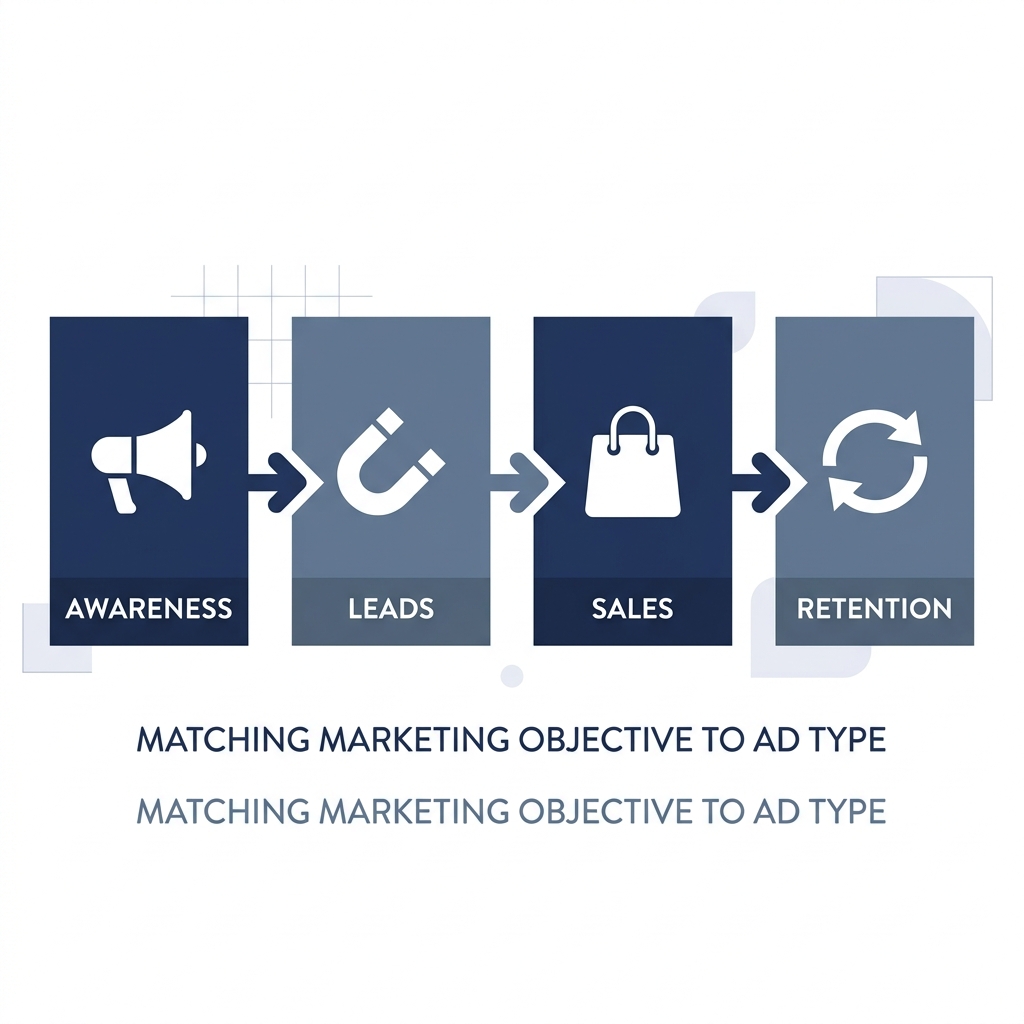
Four objectives cover the vast majority of business advertising goals:
Brand Awareness — You need people who've never heard of you to know you exist. The right tools here are display, video, and social reach campaigns. Prioritize impressions, reach, and frequency. Clicks and conversions are the wrong metrics at this stage.
Lead Generation — You need a defined pool of potential customers to express interest. Search ads, social lead-form campaigns, and retargeting are the primary tools. Measure cost per lead and lead quality, not just volume.
Sales and Conversion — You need direct revenue from the campaign. Search ads, shopping ads (where product-based), and retargeting are the most direct paths. ROAS and cost per acquisition are the metrics that matter.
Retention and Loyalty — You need existing customers to return or expand their relationship with you. Email and retargeting are the most efficient channels here — paid social and display can reinforce this, but at lower priority than other objective types.
If you want someone who has never heard of you to consider your service, a search ad won't help much — they aren't searching yet. A social awareness campaign or video ad makes more sense at that stage. This sounds obvious when stated directly, but most businesses make the opposite mistake daily.
For a deeper look at whether paid search specifically makes sense for your situation, evaluating whether PPC is the right fit for your business is worth reading before committing budget.
| Objective | Best Ad Type(s) | Why It Fits | What to Measure |
|---|---|---|---|
| Brand Awareness | Display, Video, Social Reach | Broad reach, low CPM, visual format builds recognition | Impressions, Reach, Frequency, Brand Lift |
| Lead Generation | Search, Social Lead Forms, Retargeting | Captures intent or re-engages warm audiences | CPL, Lead Quality, Lead-to-Customer Rate |
| Sales / Conversion | Search, Shopping, Retargeting | High intent or pre-warmed audience reduces wasted spend | ROAS, CPA, Revenue Attributed |
| Retention / Loyalty | Email, Retargeting, Social | Efficient re-engagement of existing relationships | Repeat Purchase Rate, LTV, Engagement Rate |
What Makes a Marketing Ad Actually Work
Knowing which ad type to use is necessary but not sufficient. Two businesses can run the same ad type on the same platform with the same budget and get completely different results. The difference usually comes down to five factors.
Targeting precision. Reaching the right audience is the foundation. A broad, untargeted campaign burns budget regardless of how good the creative is. Define your audience by behavior, intent, or specific demographic signals — not just general demographics. "Adults 25–54" is not a targeting strategy.
Creative and message relevance. The ad must match what the audience cares about at that specific moment in their decision process. An awareness-stage audience needs a reason to pay attention. A decision-stage audience needs a reason to choose you over an alternative. Mismatch here — even with perfect targeting — kills campaigns.
Offer and CTA clarity. Vague calls to action produce vague results. "Learn more" underperforms against "Get a free estimate" or "See pricing" in almost every context. The more specific and relevant the CTA, the more likely the audience is to take the action.
Landing page alignment. The post-click experience must match the ad's message and format. If your ad promises a specific outcome but the landing page is a generic homepage, you've broken the reader's trust and wasted the click. Landing page misalignment is one of the most common and most avoidable sources of wasted spend.
Testing and iteration. Effective ads are rarely first drafts. Plan for A/B testing from launch — not as a later fix when performance disappoints. One creative, one audience, one landing page tested in isolation tells you very little. Structured testing builds the data that improves performance over time.
Before You Launch: Elements of an Effective Marketing Ad
- [ ] Targeting is defined by audience behavior or intent, not just broad demographics
- [ ] Ad creative matches what the audience cares about at this specific stage of their decision
- [ ] The offer or call to action is specific and clear — not "learn more" or "visit our website"
- [ ] The landing page matches the ad's promise in both message and format
- [ ] A/B testing is planned from launch — not added as an afterthought when results disappoint
- [ ] Success metrics are defined before the campaign goes live, not after
What Marketing Ads Cost — and How to Think About Budget
Cost is one of the most common reasons businesses delay paid advertising — and also one of the most misunderstood. Here's how to think about it.
Ad pricing follows a few distinct models:
- CPC (cost per click) — you pay when someone clicks your ad. Common in search and some social campaigns.
- CPM (cost per thousand impressions) — you pay for exposure, regardless of clicks. Common in display, video, and social reach campaigns.
- CPV (cost per view) — you pay when someone watches your video ad past a threshold. Common on YouTube.
- CPL (cost per lead) — you pay per qualified lead generated. Common in some social lead-form campaigns.
- Flat rate — you pay a fixed fee for a placement, regardless of performance. Common in traditional and sponsorship advertising.
Cost varies enormously by channel, industry, and targeting. A legal or insurance keyword on Google can run $50+ per click. A niche B2B keyword in a low-competition category might run $1.50. Same platform — fundamentally different cost environment. According to industry benchmark data from WordStream, average CPCs vary significantly by industry, which is why channel cost estimates without industry context are often misleading.
Digital advertising as a category continues to grow — the IAB's digital ad revenue reporting provides useful context on where spend is concentrating across channels, which reflects where audiences are paying attention.
| Channel | Pricing Model | Typical Range | Key Variable |
|---|---|---|---|
| Google Search Ads | CPC | $1–$50+ per click | Industry and keyword competition drive the range significantly |
| Meta / Social Ads | CPM or CPC | $5–$30 CPM / $0.50–$3 CPC | Audience targeting and creative quality affect cost |
| Display / Programmatic | CPM | $0.50–$5 CPM | Low cost, lower intent — better for retargeting than cold conversion |
| Video (YouTube) | CPV / CPM | $0.03–$0.30 per view | Skippable vs. non-skippable affects rate |
| Traditional TV / Radio | Flat / CPM | Wide variance — local to national scale | Attribution is difficult; large minimum budgets common |
| OOH / Billboards | Flat rate | $250–$14,000+/month | Location and market size drive the range |
Ranges above are approximate industry benchmarks. Actual costs depend on your industry, targeting parameters, and competitive landscape.
Budget fit matters more than budget size. A $500/month search campaign targeting a niche, high-intent keyword can outperform a $5,000 display spend with no targeting discipline. Starting small with search or social allows for real learning before scaling — and that's the practical entry point for most businesses evaluating paid advertising for the first time.
One other cost factor worth naming directly: if you're running paid search through an agency, the pricing model matters. Agencies that charge a percentage of ad spend have a structural incentive to grow your budget — whether or not that growth produces proportional results. A flat-fee management model removes that incentive entirely, aligning the agency's interests with your outcomes rather than your spend level.
How to Measure Whether Your Marketing Ads Are Working
Most businesses measure what's easy to see — clicks, impressions, reach — rather than what's meaningful. That's not a data problem. It's a framing problem.
The right metrics depend entirely on your campaign objective. Applying conversion metrics to an awareness campaign, or measuring impressions for a lead-gen campaign, produces noise rather than insight.
Awareness campaigns: Track reach, impressions, frequency, and brand lift. Clicks and conversions are the wrong metrics here — you're trying to build recognition, not close a sale. If you're running a video campaign, view-through rate and completed views are more meaningful than click-through rate.
Lead generation campaigns: Track cost per lead (CPL), lead quality (what percentage of leads are actually qualified), and the lead-to-customer conversion rate. A campaign that generates 200 leads at $5 each but closes zero is not a good campaign — it's a lead quality or sales process problem.
Sales and conversion campaigns: Track return on ad spend (ROAS), cost per acquisition (CPA), and revenue directly attributed to the campaign. Google's own guidance on ROAS and campaign metrics is a useful starting point for understanding how these are calculated within a platform context.
A campaign with a high click-through rate but a 0% landing page conversion rate isn't a successful campaign. It's a targeting or landing page problem wearing a performance metric as a disguise.
Define your success metrics before the campaign launches. Retroactive benchmarking — deciding what "good" looks like after you've seen the results — distorts evaluation and makes it easy to rationalize underperformance.
| Campaign Objective | Primary Metric | Secondary Metric | What It Tells You |
|---|---|---|---|
| Brand Awareness | Reach / Impressions | Frequency / Brand Lift | How many people saw it and how often |
| Lead Generation | Cost Per Lead (CPL) | Lead Quality / Qualification Rate | Whether the campaign attracts the right people at sustainable cost |
| Sales / Conversion | ROAS / CPA | Revenue Attributed | Whether the campaign is generating profitable revenue |
| Retention / Loyalty | Repeat Purchase Rate | Engagement Rate / LTV | Whether existing customers are re-engaging |
If you're already running Google Ads and not confident your current reporting is showing you the full picture, a performance audit can surface where spend is going and what's actually driving results — without requiring any commitment to change. That's a useful first step before adjusting strategy or budget.
How Marketing Ads Fit Into a Broader Marketing Strategy
Paid advertising generates traffic and visibility quickly. But that traffic stops the moment you stop spending. That's not a flaw — it's a structural characteristic worth understanding before you allocate budget.
Organic strategies — SEO, content, building long-term organic authority through backlinks and search equity — take longer to gain traction but compound over time. A well-ranking page continues generating leads months after the content was published. Paid ads don't work that way.
The most practical approach uses both: paid ads to generate immediate reach and test messaging, organic investment to build durable, compounding visibility. Paid campaigns can surface which messages resonate with which audiences — information that makes content and SEO strategy more targeted and efficient.
Neither channel is universally better. The right proportion depends on the business's current stage, goals, and timeline. A business that needs leads next month has different needs than a business investing in positioning for the next two years. If you're still evaluating whether paid search makes sense as an entry point, understanding whether PPC fits your current business situation is a reasonable next step before committing budget.
Paid Advertising vs. Organic Marketing
| Factor | Paid Advertising | Organic / Long-Term Marketing |
|---|---|---|
| Speed to results | Immediate — traffic starts when the campaign goes live | Slow — typically 3–12 months to meaningful traction |
| Cost structure | Ongoing spend required to maintain results | Upfront investment; lower marginal cost over time |
| Sustainability | Stops when budget stops | Compounds — results persist and grow with continued effort |
| Control over messaging | High — you control placement, copy, and targeting | Moderate — subject to algorithm and search intent shifts |
| Measurability | Direct attribution available for most digital channels | Attribution is harder; multi-touch models required |
Ready to Put This Into Practice?
If you're evaluating whether paid search is worth the investment, the right starting point is a clear-eyed look at whether the channel fits your objective, your audience, and your current budget — not a decision made under pressure from an agency recommendation.
Tailored Marketing manages Google Ads for small-to-mid-sized businesses on a flat monthly fee — not a percentage of your ad spend. That structure means there's no incentive to grow your budget for its own sake. Contracts are month-to-month with no setup fees and a first-month refund if it's not a fit.
If you're not running ads yet and want to think through whether paid search makes sense for your goals, start with a conversation about whether PPC fits your business — no commitment required.
If you're already running Google Ads and want to know whether your spend is working, ask about a performance audit. It's a straightforward review of where budget is going and what's actually producing results.
Marketing is the broader discipline — it includes positioning, pricing, content, relationships, and strategy. Advertising is one paid component within that system. Running ads without a marketing strategy is like running a sales process without knowing who you're selling to or why they should choose you.
Search ads are often the most practical starting point because they reach people who are already looking for what you offer. But the real answer depends on your objective. If no one is searching for your category yet, a social awareness campaign may make more sense. Match the channel to the goal, not to platform popularity.
There's no universal answer, but starting small is almost always smarter than starting large. A focused $500–$1,000/month search campaign in a niche category can produce real data about cost per lead and conversion rate. Use that data to decide whether and how much to scale — not assumptions made before a campaign runs.
It depends on your margins and business model. A 3:1 ROAS (three dollars of revenue for every dollar of ad spend) is a common reference point, but a business with thin margins may need 6:1 to be profitable, while a high-margin service business might be comfortable at 2:1. Define your breakeven ROAS before the campaign launches, not after.
Paid ads generate immediate traffic and stop the moment you stop spending. Organic marketing — SEO, content, backlinks — builds visibility over months but compounds over time and doesn't disappear when you stop paying. Both have legitimate roles; the right balance depends on how quickly you need results and what your long-term investment horizon looks like.
Match your metrics to your objective. Awareness campaigns should be evaluated on reach and frequency — not conversions. Lead-gen campaigns should be evaluated on cost per lead and lead quality — not click-through rate. Conversion campaigns should be evaluated on ROAS and cost per acquisition. If you're measuring clicks on an awareness campaign and calling it a success, you're measuring the wrong thing.
Start with your objective: are you building awareness, generating leads, or driving direct sales? Then ask where your audience is in their decision process. If they're actively searching, search ads reach them at the right moment. If they don't know they need you yet, social or display campaigns reach them earlier. Budget should come last — not as the first filter.
Leave a Reply