
Most people searching for information about digital advertising already know it exists. What they don't know is which channel to use, why their past campaigns underperformed, or whether the budget they have is enough to generate real results.
That's the gap this article is designed to fill. You'll find a plain-English explanation of what digital advertising is (and how it differs from digital marketing), a breakdown of every major channel with honest notes on when each one works and when it doesn't, a framework for matching your business goal and budget to the right channel, and a clear-eyed look at what most beginner campaigns get wrong.
Definitions come first, but we move past them quickly. The goal is a decision you can act on — not a vocabulary lesson.
Key Takeaways
- Digital advertising is paid placement across digital channels — search, social, display, video, and more. It's one component of digital marketing, not a synonym for it.
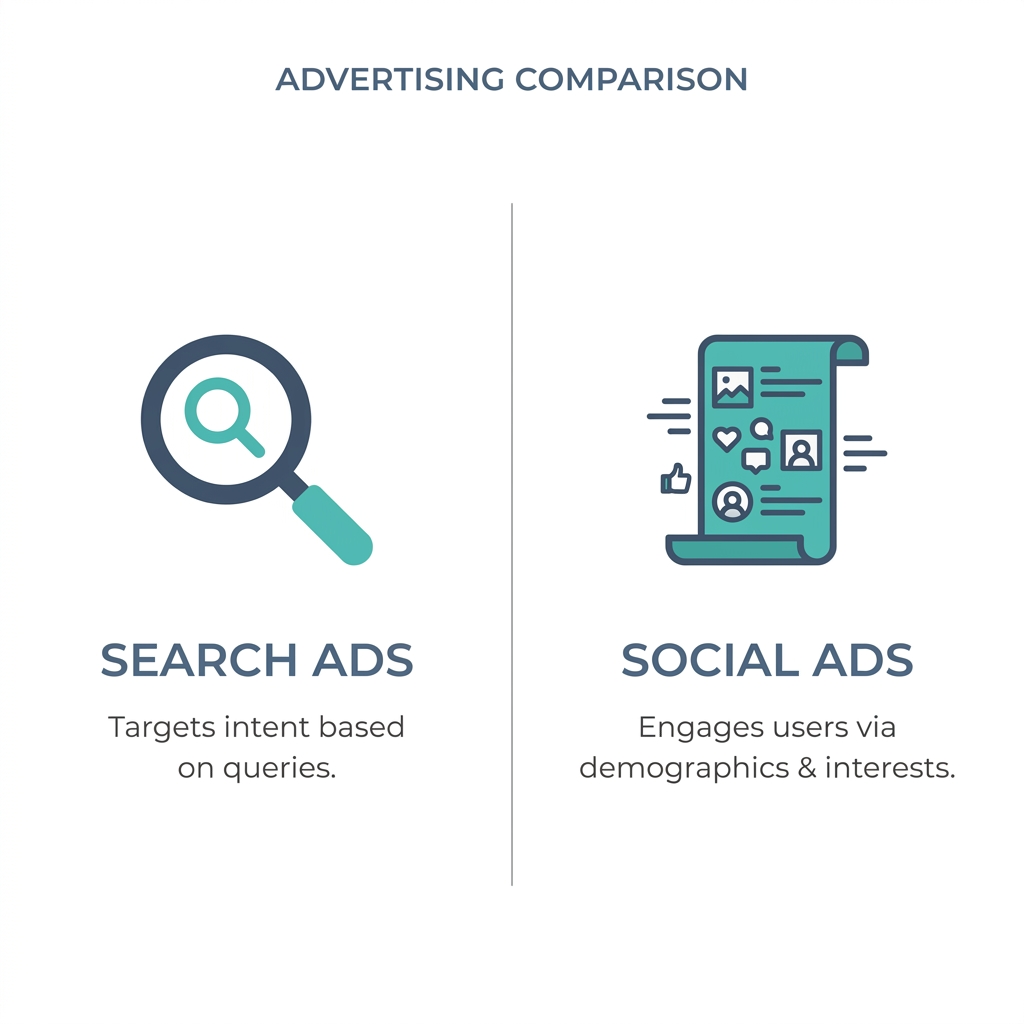
- Search advertising captures buyers who are already looking for what you sell. Social advertising reaches people who aren't searching yet. These are fundamentally different jobs, and conflating them is expensive.
- Most entry-level budgets work best concentrated on one channel. A $1,000/month budget produces useful data on one channel and nothing useful on three.
- CPC, CPM, and CPA are pricing models, not performance indicators. The model you choose should match your campaign goal — clicks, reach, or conversions.
- Most failed campaigns fail for one of three reasons: conversion tracking wasn't installed, the landing page didn't match the ad, or the budget was too small to generate real data.
- Privacy changes — particularly Apple's App Tracking Transparency and third-party cookie deprecation — are reshaping targeting. First-party data and contextual targeting are the most resilient response.
What Digital Advertising Actually Is (And What It Isn't)
Digital advertising is paid placement across digital channels — search engines, social platforms, websites, apps, and streaming services — designed to reach a specific audience and prompt a specific action. You pay to appear. The moment you stop paying, you stop appearing.
That distinguishes it sharply from digital marketing, a broader category that includes SEO, content marketing, email, and organic social. Those channels build presence over time without a direct per-placement cost. Digital advertising trades money for immediate visibility.
A concrete example: running a Google Search ad for "emergency plumber" is digital advertising. Writing a blog post that ranks organically for that same phrase is digital marketing. Both can drive a call — but they work differently, on different timelines, and with different cost structures. Treating them as the same thing leads to budget misallocation and unrealistic expectations.
| Digital Advertising | Digital Marketing | |
|---|---|---|
| Scope | Paid placement only — search, social, display, video, native, programmatic | Full mix — paid ads plus SEO, content, email, organic social |
| Cost model | Pay per impression (CPM), per click (CPC), or per conversion (CPA) | Mixed — paid channels plus time and content investment for organic |
| Speed to results | Immediate — ads can appear and generate traffic the same day they launch | Long-term — organic channels typically take months to build meaningful traffic |
| Primary goal | Drive a specific, measurable action with a defined audience now | Build brand authority, search visibility, and audience relationships over time |
For businesses weighing paid placement against organic search strategies, the decision usually isn't either/or — but understanding what each one does is essential before committing budget to either.
According to the IAB's 2024 digital advertising revenue report, digital ad spend in the United States continues to outpace every other media category — a useful signal that the infrastructure is mature and that audiences are genuinely reachable through these channels, even if choosing the right one still requires judgment.
The Major Digital Advertising Channels (And When Each One Actually Works)
The biggest mistake in choosing a digital advertising channel is treating all of them as interchangeable options. They aren't. Each channel is built for a specific stage of audience intent, and using the wrong one for your goal is one of the most common ways to waste an ad budget.
Search Advertising (Google Ads, Microsoft Ads)
Search advertising captures people who are already looking for what you sell. When someone types "HVAC repair near me" or "accounting software for freelancers," a search ad can appear at the top of the results and connect them directly to your offer. The CPC model means you pay only when someone clicks.
This intent-matching is search advertising's core advantage — and its core constraint. If no one is searching for your product or service, there's no demand to capture. A brand-new product category with zero search volume has nothing to bid on.
For most small businesses pursuing direct response, search advertising is the right starting point — not because it's cheap, but because it works with demand that already exists. If you're evaluating whether paid search is the right channel for your business, the most important question is whether your customers are actively searching for what you offer.
Social Media Advertising (Meta, LinkedIn, TikTok, Pinterest)
Social advertising is built for discovery — reaching people who aren't actively searching for what you sell. Meta's targeting lets you reach users by interest, behavior, life event, and demographic. LinkedIn reaches professionals by job title, industry, and company size. TikTok reaches younger audiences through algorithmically surfaced content.
This makes social advertising powerful for brand awareness and top-of-funnel demand generation. It's a poor fit if your primary goal is capturing buyers ready to convert today — those people are on search, not scrolling a feed.
Display Advertising
Display ads are banner and rich media placements across the web — shown to users as they browse news sites, recipe blogs, or any site on the Google Display Network. CPMs are typically low, which means broad reach at modest cost.
But low CPM also means low intent. Display advertising is most effective for retargeting (re-engaging people who visited your site) and broad awareness campaigns. Don't confuse reach with readiness to buy.
Video Advertising (YouTube, Connected TV/CTV)
Video advertising spans YouTube pre-roll and non-skippable ads, as well as the rapidly growing connected TV category — ads served to streaming audiences on platforms like Hulu, Peacock, and Roku. Both formats are storytelling-oriented and effective for awareness.
The constraint is creative. Video requires production investment. For businesses without video assets, search and text-based social formats are lower-friction starting points.
Native Advertising
Native ads match the look and feel of the surrounding editorial environment — sponsored articles, recommendation widgets, in-feed placements. They're non-disruptive, which makes them effective for discovery-stage audiences who tune out banner formats. Less effective for high-intent, conversion-focused campaigns.
Programmatic Advertising
Programmatic isn't a channel — it's a buying method. Demand-side platforms (DSPs) purchase ad inventory automatically through real-time auctions from supply-side platforms (SSPs) across the open web. Display, video, and native inventory can all be purchased programmatically.
Programmatic is efficient at scale and offers sophisticated audience targeting. It is rarely worth running below $3,000–$5,000/month, and it requires expertise to manage effectively. For most small-to-mid-sized businesses, it's not the right starting point.
Channel Comparison
Here's how the major channels compare side by side:
| Channel | Primary Intent Served | Typical Pricing Model | Best For | Key Limitation |
|---|---|---|---|---|
| Search (Google Ads, Microsoft Ads) | Active purchase or research intent | CPC | Direct response, lead generation, local services | Requires existing search demand; no inventory without search volume |
| Social (Meta, LinkedIn, TikTok) | Passive discovery, demand generation | CPM or CPC | Brand awareness, top-of-funnel, B2B lead gen (LinkedIn) | Lower purchase intent; harder to capture immediate conversions |
| Display | Passive browsing, retargeting | CPM | Retargeting, broad awareness at low cost | Very low intent; CTR is often 0.1–0.3%; easy to misread as underperforming |
| Video (YouTube, CTV) | Passive viewing, storytelling | CPM or CPV | Brand storytelling, awareness, audience that doesn't search yet | Requires quality video creative; CTV minimum budgets can be high |
| Native | Discovery, editorial adjacency | CPM or CPC | Content-adjacent discovery, audiences resistant to display formats | Harder to attribute direct conversions; works best with strong content |
| Programmatic | Retargeting, audience extension at scale | CPM | Scale-efficient inventory buying across display, video, native | Complex to run well; not cost-effective below ~$3,000–$5,000/month |
How to Choose the Right Channel for Your Goal and Budget
Most channel-selection mistakes happen because the choice is driven by what a platform offers, not what the business needs. The right framework starts with three questions: What is your goal? What is your audience's intent level right now? And is your budget large enough to generate real data on the channel you're considering?
Here's how those variables map to channel recommendations:
| Business Goal | Audience Intent | Budget Tier | Recommended Channel(s) | Why |
|---|---|---|---|---|
| Direct response / lead generation | Active search | Entry-level ($500–$1,500/mo) | Search (Google Ads) | Captures buyers already looking; CPC model keeps costs tied to clicks, not impressions |
| Brand awareness | Passive discovery | Entry-level ($500–$1,500/mo) | Social (Meta or TikTok) | Broad reach by interest and demographic; CPM model is efficient for impressions at this budget |
| Lead generation (B2B) | Passive discovery, professional context | Mid-range ($1,500–$5,000/mo) | LinkedIn Ads + Search | LinkedIn's professional targeting justifies higher CPMs; pair with search to capture branded queries |
| Retargeting existing visitors | Re-engagement | Entry-level ($500–$1,500/mo) | Display or Social retargeting | Low CPMs make retargeting affordable; audience already knows you, so intent is warmer |
| E-commerce product launch | Passive discovery (no search volume yet) | Mid-range ($1,500–$5,000/mo) | Social (Meta) + Video (YouTube) | No search demand exists yet; create it through discovery channels before capturing it on search |
| Awareness at scale | Passive viewing | Growth ($5,000+/mo) | Programmatic, CTV, YouTube | Scale and targeting sophistication justify the budget floor; below this level, signal is too thin |
A few honest constraints the table can't capture:
Minimum viable budgets matter. Search campaigns need at least $500–$1,000/month to generate enough data to optimize. Social awareness campaigns at $200–$400/month produce reach figures that look encouraging but rarely yield enough conversion data to draw conclusions. Programmatic is rarely worth running below $3,000–$5,000/month.
Creative resources are a real constraint. YouTube and CTV require video. If you don't have video assets and can't produce them, those channels aren't available to you regardless of budget. Search advertising and text-based social formats are lower-friction starting points for businesses without design resources.
Small budgets should be concentrated. A $1,000/month budget produces something useful on one channel. Split across three channels, it produces noise on all of them. Start concentrated, generate meaningful data, then expand.
If you're a local service business — plumber, HVAC contractor, dentist — with $800–$1,000/month, search advertising targeting high-intent keywords is almost always the right starting channel. Social and display awareness campaigns at that budget will generate impressions from people not ready to act.
How Digital Advertising Works: Auctions, Targeting, and Pricing Models
Understanding how digital ads are actually bought and served changes how you make decisions. Most digital advertising isn't purchased like a magazine ad — it's bought through automated auctions in fractions of a second.
Direct vs. programmatic buying. Direct buying means negotiating a placement directly with a publisher (a specific website or media outlet). Programmatic buying means your ad is bid on automatically through a demand-side platform (DSP), which purchases inventory from supply-side platforms (SSPs) that represent publishers. Most digital advertising today — including most display and video — is purchased programmatically, even when buyers aren't aware of it.
Auction mechanics. Winning a placement isn't simply about the highest bid. In Google Ads, Quality Score — determined by expected click-through rate, ad relevance, and landing page experience — directly affects both your ad rank and what you pay per click. A well-structured ad with strong keyword-to-landing-page alignment can outrank a competitor bidding 30% more and pay less per click doing it. Treating digital advertising as a spending contest rather than a relevance contest is how advertisers consistently overpay.
Targeting options in practice. The targeting methods available across platforms vary significantly:
- Keyword targeting: search ads match to the query a user types — highest intent signal available
- Interest and demographic targeting: social platforms infer intent from behavior, content consumption, and self-reported profile data
- Retargeting: re-engages users who visited your site or app but didn't convert — warm audience, typically higher conversion rates
- Custom audiences: upload a CRM list and match it to platform users — requires first-party data
- Lookalike audiences: platforms identify users statistically similar to your best customers — effective but affected by privacy signal loss (more on that in the privacy section)
- Contextual targeting: ads matched to page content, not user identity — privacy-resilient and increasingly effective as behavioral targeting degrades
Pricing models and when to use each:
Key Terms
- CPC (Cost Per Click): You pay when someone clicks your ad. Best for direct response campaigns where you want to drive traffic and conversions. Keeps cost tied to engagement rather than impressions.
- CPM (Cost Per Thousand Impressions): You pay per 1,000 times your ad is shown. Best for awareness campaigns where reach and visibility matter more than clicks.
- CPA (Cost Per Acquisition): You pay per conversion, or set a target CPA and let the platform optimize toward it. Requires a minimum volume of conversions — typically 30–50 per month — before the algorithm has enough data to optimize effectively. Not a viable option for low-volume advertisers.
- DSP (Demand-Side Platform): Software that automates the purchase of ad inventory across multiple ad exchanges — used by advertisers and agencies.
- SSP (Supply-Side Platform): Software that helps publishers sell their ad inventory programmatically.
- Retargeting: Showing ads to users who previously visited your site or interacted with your brand.
- Lookalike Audience: A platform-generated audience of users who share characteristics with your existing customers or site visitors.
- Programmatic: Automated, auction-based buying of digital ad inventory through DSP/SSP systems.
Choose your pricing model based on your goal — not which sounds cheapest. CPM campaigns judged on conversion rates will always look bad. CPC campaigns running awareness creative will always look expensive.
Measuring Digital Advertising Performance: KPIs and What Good Actually Looks Like
One of the most common ways to mismanage a digital advertising campaign is measuring it with the wrong metric against the wrong benchmark. A display campaign with a 0.15% CTR isn't failing — that's a normal display CTR. Judging it by search CTR standards would lead you to cut a campaign that's actually doing its job.
Engagement metrics measure whether your ad is being seen and noticed:
- Impressions: How many times your ad was shown
- Clicks: How many times users clicked
- CTR (Click-Through Rate): Clicks divided by impressions — signals ad relevance and creative effectiveness
- Reach: Unique users who saw the ad
- Video Completion Rate: Percentage of viewers who watched through to the end
These matter for diagnosing creative and targeting quality. They don't measure business outcomes.
Conversion metrics are what actually drive budget decisions:
- Conversion Rate: Percentage of clicks that result in a desired action (purchase, form submission, call)
- CPA (Cost Per Acquisition): Total ad spend divided by total conversions — what you paid to get one customer or lead
- ROAS (Return on Ad Spend): Revenue generated per dollar spent. A 4x ROAS means $4 in revenue for every $1 in ad spend.
- ROI: Net profit relative to total investment, accounting for cost of goods and other factors beyond ad spend
| Metric | What It Measures | Typical Benchmark Range | What a Low Result Signals | What a High Result Signals |
|---|---|---|---|---|
| CTR (Search) | Ad relevance and query match | 3–5% average (varies by industry) | Poor keyword-to-ad alignment; low relevance | Strong ad copy and keyword match |
| CTR (Display) | Creative visibility against passive audience | 0.1–0.3% | Normal for the channel; only a problem if CPM is high | Above-average creative or very targeted placement |
| CTR (Social) | Audience-to-message resonance | 0.5–1.5% (format-dependent) | Weak creative or audience mismatch | Creative and targeting are well-aligned |
| Conversion Rate | Landing page and offer effectiveness | Varies widely by industry and channel | Landing page, offer, or targeting problem | Strong message-to-market fit |
| CPA | Cost efficiency of lead or sale generation | Highly industry-specific | Over-target: bidding, creative, or audience issue | Under-target: room to scale or a sign of data error |
| ROAS | Revenue return per ad dollar | 2x–4x typical starting point; 4x+ for e-commerce | Ad spend exceeding revenue contribution | Profitable scaling opportunity |
Benchmark data cited here is drawn from WordStream's 2025 Google Ads benchmark research, which breaks down CTR and CPA by industry and channel.
Attribution matters when you're running multiple channels. Last-click attribution gives 100% of the conversion credit to the final touchpoint before a purchase — straightforward, but misleading when earlier touchpoints (a YouTube awareness ad, a social post) influenced the decision. Multi-touch attribution distributes credit across touchpoints but requires more setup and platform access to implement. The practical implication: if you're running awareness campaigns alongside direct-response campaigns and judging everything on last-click, you'll consistently undervalue upper-funnel spend and cut it prematurely.
Common Beginner Mistakes That Kill Digital Advertising Campaigns
Most campaigns that fail aren't evidence that digital advertising doesn't work. They're evidence that one or more of the following things went wrong — almost always before the first dollar of ad spend was placed.
Not installing conversion tracking before spending. This is the single most expensive mistake. Without conversion tracking, you can't see which keywords, ads, or audiences are generating results. Every optimization decision you make after that is a guess. Install it, verify it, and confirm it's firing before any campaign goes live.
Mismatching landing pages to ad creative or audience intent. An ad promising a specific discount that sends users to the homepage — or a search ad for a specific service that lands on an "About Us" page — destroys conversion rates regardless of how good the targeting is. The ad creates an expectation. The landing page either fulfills it or it doesn't.
Under-budgeting to the point of meaninglessness. A $100/month budget in a competitive Google Ads market might generate five clicks. You cannot make optimization decisions from five clicks. If your budget can't generate at least 50–100 clicks per month on a focused keyword set, you don't have enough data to optimize — you're just spending.
Spreading a small budget across too many channels. This produces noise everywhere and insight nowhere. Start on one channel, generate data, learn what works, then consider adding a second channel.
Ignoring negative keywords in search campaigns. Without a negative keyword list, your search ads will match to irrelevant queries and burn budget on traffic that was never going to convert. Reviewing the search terms report in the first two weeks of a campaign is non-negotiable. This isn't an optional optimization — it's basic setup.
Accepting platform defaults without review. Google's broad match, Meta's Advantage+ audience expansion, and similar defaults are designed to maximize inventory consumption — not your conversion rate. They are a good starting point only if you review and narrow them. Leaving them as-is means you're letting the platform decide who sees your ads.
If you've run Google Ads and seen poor results, the diagnostic usually starts here: Was conversion tracking installed and verified? Did the landing page match the ad's specific promise? Was the keyword match type set to broad without negative keywords? In most underperforming campaigns, one of these is the culprit. If you'd rather have someone else run that diagnostic, a Google Ads audit is a low-stakes way to find out what's actually going wrong.
Before you launch, confirm each of these:
- [ ] Conversion tracking is installed and verified before any spend begins
- [ ] Landing page matches the specific ad offer and audience intent — not just the general category
- [ ] Budget is sufficient to generate at least 50–100 clicks per month on a focused keyword set
- [ ] Campaign is not spread across multiple channels simultaneously at entry-level budget
- [ ] Negative keyword list is built and reviewed before search campaigns go live
- [ ] Targeting parameters have been reviewed and narrowed from platform defaults
- [ ] Success metrics are defined before launch — not determined after the fact based on what looks good
Privacy Changes and What They Mean for Digital Advertising Targeting
Anyone evaluating or running digital advertising right now is operating in a different targeting environment than existed three years ago. Two changes in particular have had material impact on how digital ads are targeted, measured, and optimized.
Third-party cookie deprecation. Browsers are phasing out the third-party cookies that have powered much of behavioral targeting, cross-site retargeting, and attribution measurement in display and programmatic advertising. When a user visits multiple websites, third-party cookies have historically allowed advertisers to build audience profiles and serve retargeting ads across those sites. As that infrastructure degrades, audience segmentation, frequency capping, and attribution accuracy for display-heavy campaigns all become less reliable.
Apple's App Tracking Transparency (ATT). Introduced in 2021, Apple's ATT framework requires apps to request explicit user permission before tracking activity across other companies' apps and websites. The majority of users have declined. This has significantly reduced the conversion signal available to Meta and other social platforms — particularly for iOS users. ROAS figures reported in Meta Ads Manager are now systematically understated for that segment, because attributed conversions that happened on iOS devices are underreported.
The practical response: first-party data.
- Email lists and CRM data belong to your business — they're unaffected by cookie deprecation or ATT
- Website pixel audiences (visitors who came to your site) are built on your own infrastructure, not third-party cookies
- Customer match lists (uploading your CRM to Google or Meta to match against platform users) are a durable targeting signal that doesn't depend on third-party tracking
- Lookalike audiences built from first-party data remain more reliable than those built from platform-inferred behavioral signals
- First-party data is a targeting asset that becomes more valuable as industry-wide signal degrades — investing in it now creates a durable competitive advantage
Contextual targeting — placing ads based on the content of the page they appear on, not the identity of the viewer — is immune to cookie deprecation and has shown renewed effectiveness as behavioral targeting degrades. It's not a replacement for all behavioral methods, but for display and native placements, it's the most privacy-resilient targeting approach available.
Privacy changes are not the end of digital advertising. They're a structural shift that rewards businesses with strong first-party data assets and penalizes those who relied entirely on third-party behavioral targeting. Build better data infrastructure now.
Conclusion: Match the Channel to the Goal
Digital advertising gives you precise control over who sees your message and when — but that precision is only useful if you start with the right channel for the right goal. Search advertising captures demand that already exists. Social advertising creates demand with audiences who aren't looking yet. Display and programmatic extend reach efficiently at scale. None of these is universally better. The right one depends on your business goal, your audience's intent level, and a budget large enough to generate real data.
Most campaigns that underperform don't fail because digital advertising doesn't work. They fail because the channel didn't match the goal, the budget was too thin to optimize, or the conversion tracking wasn't in place to measure anything.
If you're starting from scratch — or starting over after a disappointing experience — and you want paid search managed without a percentage-of-spend incentive structure, Tailored Marketing offers flat-fee Google Ads management with month-to-month contracts, no setup fees, and a first-month refund guarantee. It's a low-risk way to get started with someone who has an incentive to make your campaigns work, not to grow your ad spend. Schedule a consult to talk through whether it's the right fit.
Digital advertising is paid placement across digital channels — search engines, social platforms, websites, apps, and streaming services — where you pay for visibility based on impressions, clicks, or conversions. Digital marketing is a broader category that includes digital advertising plus unpaid tactics like SEO, content marketing, email, and organic social. Digital advertising delivers immediate visibility; those other channels build long-term presence. The two work best together, but they operate on different timelines and cost structures.
For most small businesses pursuing direct response (leads, calls, purchases), search advertising is the right starting point — it captures buyers who are already searching for what you sell. If you're launching a new product with no search demand, or building brand awareness, social advertising is a better fit. Programmatic and CTV make more sense at $3,000+/month. Start with one channel, generate data, then expand.
Search campaigns (Google Ads) are viable starting at $500–$1,000/month in most local markets — enough to generate meaningful data on a focused keyword set. Social awareness campaigns need at least $1,000–$1,500/month to generate enough conversion data to optimize. Programmatic rarely makes sense below $3,000–$5,000/month. The issue isn't whether digital advertising is affordable — it's whether the budget you have is sufficient for the channel you're considering.
Programmatic advertising is an automated method for buying display, video, and native ad inventory across the open web through real-time auctions. A demand-side platform (DSP) bids on your behalf across inventory made available by supply-side platforms (SSPs). It's efficient at scale and offers sophisticated audience targeting, but it's complex to manage and rarely cost-effective below $3,000–$5,000/month. Most small businesses don't need it — search and social will serve them better at entry-level budgets.
Compare your results to channel-appropriate benchmarks. Search ads typically see 3–5% CTR; display is normal at 0.1–0.3%. Conversion metrics — CPA and ROAS — matter more than engagement metrics for business decisions. If you don't have conversion tracking installed, you can't answer this question at all — that's the first thing to verify. Set your success metrics before launch, not after.
Apple's App Tracking Transparency (ATT) reduced the conversion signal available to social platforms like Meta for iOS users, causing reported ROAS to be understated. Third-party cookie deprecation is degrading behavioral targeting and cross-site retargeting in display and programmatic. The most resilient response is investing in first-party data — email lists, CRM data, website pixel audiences, and customer match lists — which are unaffected by these changes. Contextual targeting (matching ads to page content, not user identity) is also gaining effectiveness as a privacy-safe alternative.
Leave a Reply