
You've heard PPC can drive traffic fast. You've also heard it can drain budget fast. Both are true — and the difference almost always comes down to whether you understand how it actually works before you spend your first dollar.
This article covers the mechanics behind the ad auction, what clicks realistically cost by industry and platform, which platform matches your audience and goal, and what separates campaigns that generate returns from campaigns that waste money. If you are past the "what does PPC stand for" question and moving toward "should I actually do this," this is the guide for that.
Key Takeaways
- PPC means you pay only when someone clicks your ad — not for impressions. But a click is only worth paying for if the action it generates is worth more than the click cost.
- Ad Rank is calculated as Quality Score × your maximum bid — which means a better-optimized ad can beat a higher bid and pay less per click, not more.
- Most PPC budget waste traces back to three setup failures: no conversion tracking, no negative keywords, and sending traffic to the homepage instead of a dedicated landing page.
- Google Ads is not automatically the right starting platform — Microsoft, Meta, and Amazon each match different audiences and buying stages.
- You can calculate whether PPC is financially viable before you spend: divide your cost-per-click by your conversion rate to get cost per acquisition, then compare it to what a customer is actually worth.
What PPC Ads Are and How the Pay-Per-Click Model Works
Most advertising charges you for exposure. PPC charges you for action.
PPC — pay-per-click — is a pricing model where the advertiser pays only when a user clicks the ad. If your ad appears a thousand times and nobody clicks, you owe nothing. That is the core of the model: you are buying a visit, not visibility.
To understand why that matters, contrast it with CPM (cost-per-thousand impressions). With CPM, you pay $5 for every 1,000 times your ad is shown — whether anyone clicks or not. With PPC, you pay only when someone clicks — say, $1.50 per click, and nothing if they scroll past. CPM works when the goal is awareness. PPC works when the goal is action.
PPC ads appear across several surfaces: search engines like Google and Bing, social platforms like Meta (Facebook and Instagram) and LinkedIn, and e-commerce marketplaces like Amazon. This is not just a Google thing. The pay-per-click model runs across all of these environments, even though the auction mechanics and audience context differ significantly by platform.
The framing that anchors everything else: a click is only worth paying for if the value of the resulting action — a purchase, a lead, a booking — exceeds what you paid for that click. That calculation is what separates informed PPC buyers from people who run campaigns and wonder why they lost money.
How the Ad Auction Works: Ad Rank, Quality Score, and What Drives Your CPC
Here is a common misconception: the advertiser who bids the most wins the top ad slot. That is not how it works.
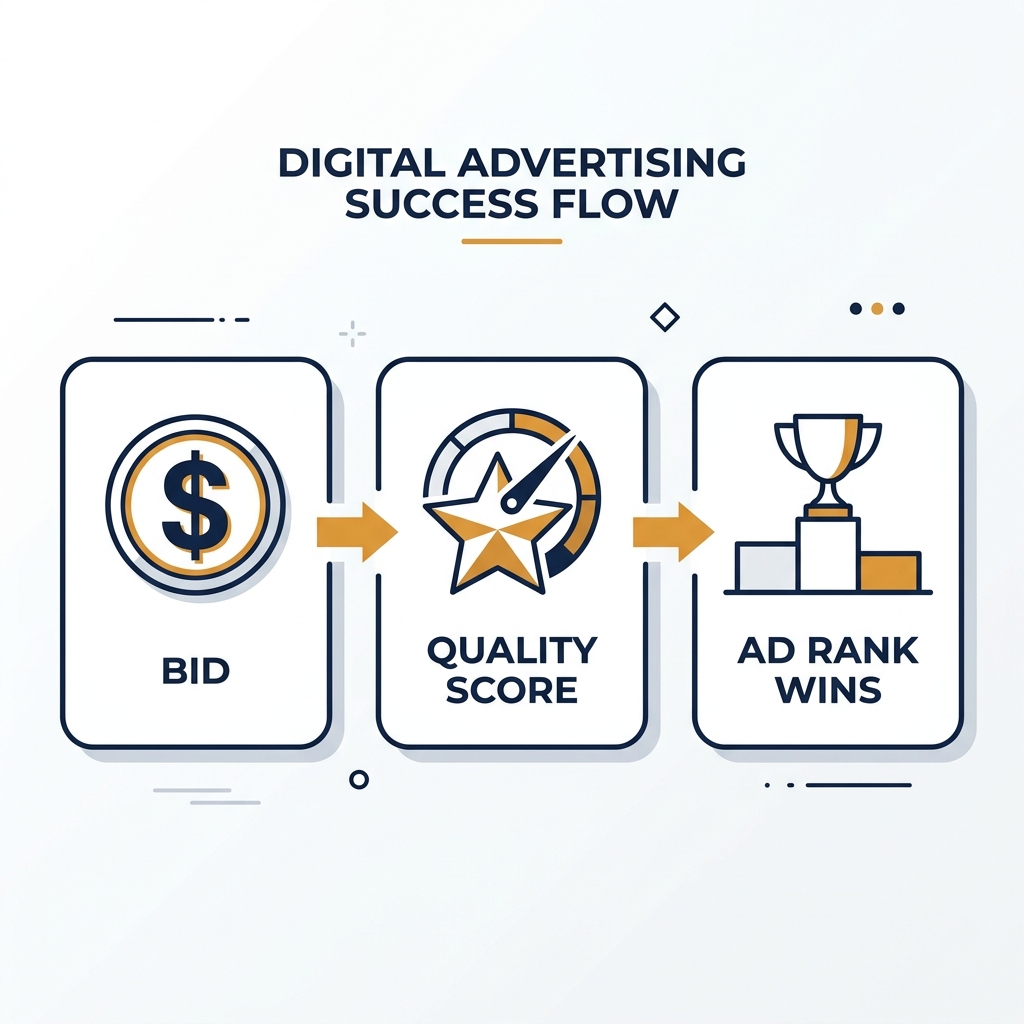
Every time a user performs a search, Google runs an auction to determine which ads appear and in what order. The outcome is not determined by bid alone — it is determined by Ad Rank.
Ad Rank = Quality Score × Maximum Bid
Quality Score is a 1–10 rating Google assigns to your keyword-ad-landing page combination. It reflects three components:
- Expected click-through rate — how likely users are to click your ad given the keyword
- Ad relevance — how closely your ad copy matches the searcher's intent
- Landing page experience — whether your landing page delivers what the ad promises
The non-obvious implication: a higher Quality Score can win placement over a higher bid — and the winner actually pays less per click because the formula works in their favor. Google's official documentation on Quality Score explains the components in detail, but here is what it looks like with real numbers:
Worked Ad Rank Example:
| Advertiser | Max Bid | Quality Score | Ad Rank | Who Wins? |
|---|---|---|---|---|
| Advertiser A | $3.00 | 4 | 12.0 | Loses |
| Advertiser B | $1.50 | 9 | 13.5 | Wins top slot |
Advertiser B wins the top position with a $1.50 bid against a $3.00 competitor. And here is the part that surprises most people: what Advertiser B actually pays is not their max bid. The actual CPC is calculated as just enough to beat Advertiser A's Ad Rank, plus one cent. In practice, Advertiser B might pay $1.34 per click while Advertiser A pays more and still doesn't get the top slot.
This is why Quality Score is worth understanding before you start raising bids. Advertisers who improve their ad relevance and landing page experience have a structural cost advantage over those who just throw money at the auction.
Keyword Strategy: Match Types, Negative Keywords, and Why They Control Your Budget
Pick the wrong keywords and you waste money on irrelevant traffic. Pick the right keywords with the wrong match type settings and the same thing happens — just more slowly.
Google Ads gives you four keyword match types that control how loosely or strictly your ads match to search queries:
- Broad match — your ad can appear for searches related to your keyword, including synonyms, implied topics, and variations Google infers are relevant
- Phrase match — your ad appears for searches that include the meaning of your keyword phrase, in order, with words before or after allowed
- Exact match — your ad appears only when the search closely matches your keyword with little variation
- Negative keywords — these exclude searches containing the specified terms, preventing your ad from appearing on irrelevant queries
Keyword Match Type Reference
| Match Type | Example Keyword | Would Trigger | Would NOT Trigger |
|---|---|---|---|
| Broad | running shoes | "best sneakers for jogging," "athletic footwear sale" | Unlikely to exclude much without negatives |
| Phrase | "running shoes" | "buy running shoes online," "running shoes for women" | "shoes for running trails" (meaning shift) |
| Exact | [running shoes] | "running shoes," "running shoe" | "cheap running shoes," "best running shoes" |
| Negative | -free | Anything not containing "free" | "free running shoes," "running shoes free shipping" |
Negative keywords deserve more attention than most beginners give them. Without a negative keyword list, a broad match campaign will trigger on queries you would never consciously target — and you will not notice until you pull a search term report and see budget spent on searches that have nothing to do with your product. Building your negative keyword list before launch is not advanced optimization. It is basic budget protection.
The long-tail vs. short-tail tradeoff also matters here. A keyword like "shoes" gets enormous search volume but converts poorly and costs more. A keyword like "waterproof trail running shoes for wide feet" has far less volume but much higher intent and often a lower CPC. For most businesses entering PPC, starting with longer, more specific keywords gives you better conversion data without burning through budget learning what does not work.
Keyword strategy is not a one-time setup task. Reviewing your search term report weekly — especially in the first few months — reveals what queries your ads are actually triggering, and that list should be refined regularly.
PPC Platform Comparison: Google, Microsoft, Meta, and Amazon
Defaulting to Google Ads because it is the most familiar is not a strategy. Platform selection should be a deliberate decision based on where your audience is in the buying journey and what action you need them to take.
Here is how the four major PPC platforms compare. Platform choice depends on where your audience is and what they are ready to do.
| Platform | Best For | Avg. CPC Range | Audience Intent | Key Tradeoff |
|---|---|---|---|---|
| Google Ads | Businesses targeting active searchers across most industries | $1–$50+ (highly industry-dependent) | High — users are actively searching for a solution | Highest reach and intent, most competitive CPCs |
| Microsoft Ads | B2B, finance, and categories with older or higher-income buyers | $1–$15 (typically 20–35% lower than Google) | High — same search intent model as Google | Smaller audience volume, but less competition and lower cost |
| Meta Ads | Visually driven products, e-commerce, brand awareness, top-of-funnel | $0.50–$3 | Interest-based — users are not actively searching | Lower purchase intent than search; better for discovery and retargeting |
| Amazon Ads | Physical product sellers on Amazon marketplace | $0.50–$2 | Very high — shoppers are ready to buy | Only relevant if you sell on Amazon; limited reach outside the marketplace |
A few things worth noting:
Google Ads is the right default for most businesses that need to capture demand from people actively searching for what they offer. The CPCs are higher, but the intent is the clearest.
Microsoft Ads is consistently underused. The audience skews older and higher-income, and CPCs run meaningfully lower than Google in many categories. If you are in B2B or targeting professionals, it is worth testing in parallel.
Meta Ads works differently from search. You are not capturing demand — you are creating it. Users are scrolling, not searching. This makes Meta better for visually driven products, awareness campaigns, or retargeting audiences who already know your brand. It is a different funnel position, not an inferior platform.
Amazon Ads has one of the highest-intent audiences of any platform — people who are on Amazon are usually ready to buy. But if you do not sell physical products on Amazon, this platform is essentially irrelevant to you.
What PPC Actually Costs — And How to Know If a Click Is Worth It
PPC cost anxiety is almost always a proxy for not knowing the math. Once you can calculate your cost per acquisition and compare it to what a customer is worth, the question of whether PPC is expensive becomes answerable — not abstract.
CPC benchmarks by industry (sourced from WordStream's Google Ads benchmarks; figures are approximate ranges and vary significantly by keyword competition, geography, and bid strategy):
- Legal and financial services: $5–$50+
- SaaS and software: $3–$15
- E-commerce (retail): $0.50–$3
- Healthcare: $2–$10
- Home services: $3–$20
- B2B services: $3–$25
These are ranges, not guarantees. Your actual CPC depends on your Quality Score, competition in your specific keyword market, and your bidding strategy.
Minimum viable budget: One of the most common structural mistakes is underfunding a campaign. A $5/day budget in a market with a $10 average CPC means you might get zero or one click per day — not enough data to tell whether anything is working. The algorithm needs volume to optimize. Running a thin campaign and concluding "PPC doesn't work" is not a fair test of the channel. It is a test of what happens when budget is too low to generate meaningful signal.
ROI calculation framework:
Here is the math that answers whether PPC is viable for your situation:
- Start with your average CPC — say, $2.00
- Divide by your conversion rate — say, 3% (0.03)
- Cost per acquisition = $2.00 ÷ 0.03 = $66.67
- Compare to customer value: if a customer is worth $200, PPC is profitable. If they are worth $40, it is not.
Substitute your own numbers. If the cost per acquisition comes in below the value of a customer, PPC can work. If it does not — or if you do not know what a customer is worth — that is the problem to solve before running ads, not after.
Conversion tracking is not optional. Without it, you cannot run this calculation, you cannot optimize toward what is working, and you are effectively spending money with no feedback loop. Installing and verifying conversion tracking before any spend begins is the single highest-leverage setup task in PPC.
One other cost variable worth naming: agency fee model. If an agency charges a percentage of your ad spend, their revenue grows when your budget grows — regardless of whether the results improve. Flat-fee models align differently: the agency's fee stays fixed, so their incentive is to improve performance, not to grow your spend. That distinction has a real effect on how campaigns get managed over time.
If you are trying to determine whether PPC is right for your specific business situation, the ROI framework above is the right starting point before committing any budget.
PPC vs. SEO: Which Channel Fits Your Situation
This is a question most articles dodge by saying "do both." That is technically true in the long run, but unhelpful when you have limited budget and need to choose where to start.
Here is the honest tradeoff:
PPC delivers immediate visibility — and it stops the moment you stop paying. There is no compounding return. Every click costs money in perpetuity. If your campaign is profitable, that is fine. But PPC builds nothing that persists once the budget runs out.
SEO builds slowly and compounds over time. For most competitive keywords, you should not expect meaningful organic traffic in less than 3–6 months, and often longer. But once you rank, clicks are free. A well-ranked page generates traffic for years without ongoing per-click cost.
They also work well together in a specific way: PPC search term data — especially which queries actually convert — is some of the highest-quality input you can feed into an SEO content strategy. The platforms are not competitors. They answer different constraints.
When to prioritize PPC:
- Your site is new and has no organic authority
- You need results within weeks, not months
- You are running a time-sensitive promotion
- You want to test messaging before committing to long-form content
- You are targeting high-intent keywords where organic ranking is not yet possible
When to prioritize SEO:
- You have limited budget for ongoing monthly ad spend
- Your business model depends on content and education
- You are building for long-term, compounding growth
- Your market has low CPC competition and high organic search volume
Use the matrix below as a rough filter — not a definitive answer. Most businesses eventually benefit from both.
| Situation | Lean PPC | Lean SEO | Consider Both |
|---|---|---|---|
| New site, no organic authority | Yes | No | Only if budget allows |
| Time-sensitive launch or promotion | Yes | No | No |
| Tight budget, limited monthly spend | Cautiously | Yes | When budget grows |
| Content-driven business model | No | Yes | PPC for top converters |
| Testing new messaging or offer | Yes | No | After message is validated |
| Established site with some rankings | Optional | Yes | PPC to fill gaps |
| High-intent, high-CPC competitive market | Only if ROI math works | Yes, long-term | Layer in over time |
If you are not sure which category your situation falls into, evaluating PPC fit for your business before committing to either channel is worth the time.
Why PPC Campaigns Fail: The Most Common Mistakes Before and After Launch
Most PPC campaigns that fail do not fail because the platform does not work. They fail because the campaign was set up wrong, underfunded, and never properly diagnosed. The failure modes are well-documented — and almost entirely avoidable.
No conversion tracking. This is the most common setup failure and the one with the highest cost. Without conversion tracking, you cannot see which keywords, ads, or landing pages are generating results. You cannot calculate ROI. You cannot optimize. You are essentially running a campaign with no feedback loop. Campaigns launched without verified conversion tracking are not experiments — they are just spending.
Sending all traffic to the homepage. When a user clicks an ad for "emergency roof repair" and lands on a general contractor homepage, they leave. The ad promised a specific solution; the landing page delivered something generic. This mismatch destroys conversion rate and simultaneously hurts Quality Score — which raises your CPC. Running ads to your homepage instead of a dedicated landing page is one of the fastest ways to waste budget.
Broad match keywords without a negative keyword list. Broad match is the most flexible — and the most dangerous — match type for beginners. Without negative keywords in place, your ads will trigger on queries that are completely irrelevant to your offer. You will spend real money before you notice, and by the time you pull a search term report, the budget damage is already done.
Set-and-forget campaigns. Google's automated bidding strategies optimize toward the goal you set — but if that goal is poorly defined, or if the campaign has insufficient conversion data, the algorithm optimizes toward the wrong thing. PPC is not a passive channel. Campaigns need weekly review, especially in the first 60–90 days when the algorithm is still learning and match type drift is most likely.
Underfunding the campaign. A campaign running $5/day in a $10 CPC market generates at most one click per day. That is not enough volume to make any meaningful optimization decision. If your budget is too thin to generate 20–30 conversions per month — the minimum threshold for most smart bidding strategies to function properly — you will never get a fair read on whether the channel works. This is a structural problem, not a performance problem.
Pre-Launch PPC Checklist
Before you run your first ad — or diagnose why an existing campaign is underperforming — verify these seven things:
- [ ] Conversion tracking is installed and confirmed firing correctly
- [ ] Dedicated landing pages are built for each ad group (not the homepage)
- [ ] A negative keyword list is built and applied before launch
- [ ] Match types are intentionally selected — not defaulted to broad across the board
- [ ] Daily budget is set high enough to generate meaningful data (at minimum, enough for 2–3 clicks per day)
- [ ] Campaign goals are defined and tied to a measurable outcome (lead, purchase, call)
- [ ] A reporting baseline is established so you can evaluate performance against a clear standard
If you are already running a campaign and it is underperforming, run through this list before changing bids or pausing keywords. The problem is usually on this list.
Is Managed PPC Worth It — And What to Look For
Once you understand how PPC actually works, a new question comes up: should you manage it yourself or work with someone who does this every day?
There is no universal answer. But a few things clarify the decision:
If the seven items on the checklist above feel manageable and you have time to review campaign data weekly, self-management is viable — especially in lower-competition markets. If you are in a competitive space with high CPCs, the margin for setup errors is smaller and the cost of mistakes is higher.
If you decide to work with an agency, fee model matters. An agency charging a percentage of ad spend has a financial incentive to grow your budget — whether that benefits your results or not. A flat-fee model removes that incentive: the agency gets paid the same regardless of your spend level, so their focus stays on improving performance.
Tailored Marketing offers flat-fee Google Ads management on a month-to-month basis with no setup fees and a first-month refund. The structure is designed to make it genuinely low-risk to find out whether managed PPC fits your situation — not to lock you in before you have data.
If you want a straight conversation about whether your current setup is likely to generate returns, or whether the channel makes sense for your business at all, a diagnostic consultation is a practical starting point.
There is no universal minimum. The meaningful threshold is whether your budget is high enough to generate enough clicks to make optimization decisions. In low-competition markets, $500–$1,000/month can be sufficient. In competitive industries like legal or financial services where CPCs run $20–$50+, meaningful data requires significantly more. The floor is not a dollar amount — it is a click volume question.
PPC (pay-per-click) is the advertising model. CPC (cost-per-click) is the metric that measures what each click actually costs within that model. When someone says "our CPC is $2.50," they are reporting the average price paid per click in a PPC campaign. PPC is the structure; CPC is the output.
It depends on the math. If a click costs $2.00 and 3% of visitors convert, your cost per acquisition is about $67. If your customer is worth more than $67, PPC is potentially profitable regardless of business size. If your customer is worth less, no amount of optimization fixes a negative unit economics problem. The question is not whether PPC is too expensive — it is whether the math works for your specific offer and conversion rate.
Ads can appear within hours of launch. Meaningful performance data — enough to make confident optimization decisions — typically takes 30–90 days, depending on click volume and conversion frequency. Smart bidding strategies often need 30–50 conversions to exit the learning phase and start performing efficiently. Expecting clear results in week one is a common source of premature campaign pauses.
It varies significantly by industry and keyword type. As a rough benchmark, search ads across most industries average 3–6% CTR, with competitive commercial keywords often lower and highly specific long-tail keywords sometimes higher. A higher CTR improves Quality Score, which lowers CPC. If your CTR is consistently below 1–2% on search, ad relevance is worth reviewing before adjusting bids.
Dedicated landing pages consistently outperform homepages for ad traffic. The reason is intent match: a user who clicked an ad for a specific product or service expects to land on a page about exactly that. A homepage is designed for general audiences. The mismatch reduces conversion rate and — because landing page experience is a Quality Score component — it also raises your CPC. A dedicated landing page is not optional if you want campaigns to perform efficiently.
Leave a Reply