
If you searched for "ads" or "advertising platforms" recently, you probably landed on a Google page telling you Google Ads is the answer, a Meta page explaining why Facebook and Instagram reach billions, or an Amazon page showing how Sponsored Products can grow your sales. Every one of those pages is right — for some businesses. None of them can tell you whether their platform is right for your business, because they have an obvious interest in your answer.
This article is different. It covers the four major advertising platforms — Google Ads, Meta Ads, Microsoft Advertising, and Amazon Ads — with honest cost benchmarks, real limitations, and a concrete decision framework built around your goal and budget. Paid advertising is one tool in a broader digital marketing mix, but it can be a powerful one when matched correctly. When mismatched, it is mostly an expensive lesson.
Here is what you will find below: a plain-language overview of ad formats, an independent comparison of the major platforms, a decision framework for choosing where to start, realistic cost expectations, the metrics that actually matter, and the most common (and preventable) mistakes advertisers make.
Key Takeaways
- No single platform is right for every business. Your goal, audience, and budget determine the fit — not which platform has the biggest name.
- Google Ads dominates high-intent search traffic. Meta Ads excel at audience targeting and creative-driven discovery. Amazon Ads are built for product sellers. Microsoft Advertising offers lower CPCs with an older, higher-income audience.
- Most ad failures are preventable: wrong platform, wrong campaign objective, underfunded spend, or missing conversion tracking.
- You need a realistic test budget and a defined success metric before you can evaluate whether ads are working at all.
- If you hire an agency, how they charge you changes whose interests they are actually serving.
What Are Online Ads? The Main Ad Types Explained
Before comparing platforms, it helps to understand what you are actually buying. Digital advertising is not one thing — it is a collection of formats that appear in different places and serve different goals.
Search ads appear on search engine results pages when someone types a relevant query. A plumber who runs a search ad for "emergency plumber near me" pays each time someone clicks. The goal is almost always a phone call or a form fill from someone who already has the problem and is actively looking for a solution.
Display ads are image or banner ads that appear on websites, apps, and news publications across a network. A software company running display ads on industry news sites pays per thousand impressions (or per click). The goal is usually brand awareness or retargeting visitors who did not convert the first time.
Social ads run inside social media feeds — Facebook, Instagram, LinkedIn, TikTok, and others. They interrupt the scroll rather than responding to a search query, which means the audience is in browsing mode, not buying mode. Targeting is based on interests, demographics, and behaviors rather than search intent.
Video ads appear before or during video content, most commonly on YouTube. They work well for brand storytelling, product demonstrations, and reaching audiences early in the consideration process.
Shopping ads display a product image, price, and retailer name directly on the search results page. They are triggered by product-related searches and are most relevant for ecommerce businesses. Google Shopping and Amazon Sponsored Products are the two major examples.
Connected TV (CTV) ads run on streaming platforms. They function more like traditional television advertising — broad reach, no direct-click action — and are generally only relevant once a business has a strong brand-building budget.
The key insight here: ad formats are not interchangeable. Choosing the wrong format for your goal is as costly as choosing the wrong platform. A brand awareness display campaign will not generate leads the way a search campaign will, even on the same platform. Most beginners skip this step and then blame the platform when results disappoint.
Digital advertising differs from traditional advertising in three meaningful ways: you pay for performance (clicks or impressions) rather than placement time, results are measurable in near-real-time rather than weeks after the fact, and campaigns can be adjusted while they are running rather than after a print run is locked.
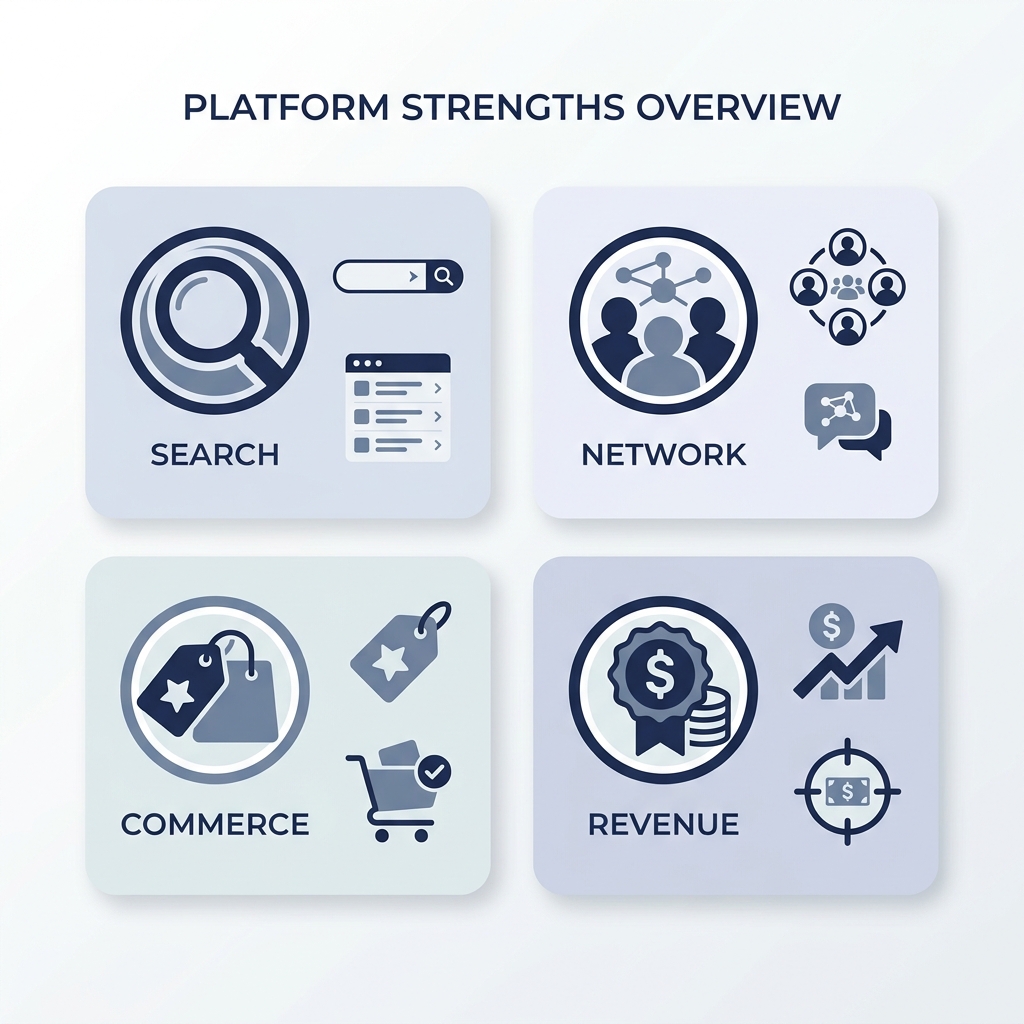
The Major Ad Platforms Compared: Google, Meta, Microsoft, and Amazon
Every major platform has a home-court advantage — a specific audience, a specific intent level, and a specific type of advertiser it genuinely serves best. Defaulting to Google because it is the biggest name is not a strategy. Here is an honest look at each.
Google Ads is the largest search advertising network in the world. Its strength is capturing high-intent traffic — people who are actively searching for what you sell. For a local HVAC company, a law firm, or a home services business, that intent is enormously valuable. The honest caveat: competitive verticals are expensive. Legal, insurance, and financial services commonly see CPCs of $50–$100 or more per click, according to industry benchmark data from WordStream. A $1,500/month budget in one of those industries does not go very far.
Meta Ads (Facebook and Instagram) offer something Google cannot: granular audience targeting based on interests, life events, demographics, and behaviors. If you are a direct-to-consumer apparel brand trying to reach women aged 28–45 who follow specific lifestyle accounts, Meta gets you closer than a search keyword ever will. The honest caveat: iOS privacy changes have reduced tracking accuracy meaningfully, which makes attribution harder than it used to be. Meta also requires strong creative — dull ads get ignored in a busy social feed.
Microsoft Advertising (Bing Ads) runs on Bing, Yahoo, and partner search networks. Its audience skews older and higher-income than Google's, which matters more than it sounds for certain businesses (financial services, B2B, healthcare). Average CPCs run roughly 20–35% lower than comparable Google Ads campaigns. The honest caveat: the total audience is significantly smaller, so if you need volume, Microsoft alone is rarely sufficient — but as a budget-efficient complement to Google, it is often underused.
Amazon Ads — primarily Sponsored Products, Sponsored Brands, and Sponsored Display — are relevant if and only if you sell on Amazon or a comparable marketplace. The purchase intent on Amazon is about as high as it gets: people are on the platform specifically to buy things. The honest caveat: if you are not selling on Amazon, these ads are not for you. They do not drive traffic to your own website.
According to IAB digital advertising revenue data, Google and Meta together account for a dominant share of total U.S. digital ad spend — which explains why they are the default starting point for most advertisers, though not always the right one.
Here is how the four major platforms compare at a glance:
| Platform | Audience Reach | Primary Ad Types | Avg. CPC Range | Best For | Key Limitation |
|---|---|---|---|---|---|
| Google Ads | Very large — dominates search globally | Search, Display, Shopping, YouTube Video | $2–$5 most industries; $50–$100+ in legal/insurance/finance | High-intent local services, ecommerce, B2B lead gen | High CPCs in competitive verticals; steep learning curve |
| Meta Ads (Facebook/Instagram) | Very large — deep demographic and interest targeting | Feed images/video, Stories, Reels, Carousel | $0.50–$2.00 for many consumer categories | Brand awareness, DTC ecommerce, retargeting, audience-based discovery | iOS privacy changes reduce tracking accuracy; creative-dependent |
| Microsoft Advertising | Smaller than Google — skews older, higher income | Search, Shopping, Audience Network | 20–35% lower than Google in comparable categories | B2B, financial services, older demographics, budget-limited search campaigns | Smaller audience volume; less reach for consumer brands |
| Amazon Ads | Amazon's buyer audience — active purchase intent | Sponsored Products, Sponsored Brands, Sponsored Display | $0.35–$1.50 for many product categories | Product sellers on Amazon marketplace | Only useful if you sell on Amazon; no off-platform website traffic |
How to Choose the Right Platform for Your Goal and Budget
The most common mistake in platform selection is starting with the platform rather than starting with the goal. Here is a more useful sequence.
Step 1: Define your actual goal. The four primary advertising goals each favor different platforms:
- Brand awareness: Meta Ads, YouTube (Google), Google Display Network
- Lead generation: Google Search Ads, Meta Ads
- Direct product sales: Google Shopping, Amazon Ads, Meta Ads
- App installs: Meta Ads, Google Universal App Campaigns
Step 2: Consider your business type. This changes the math significantly.
- Local service business (HVAC, plumbing, legal, dental): Google Ads search campaigns are almost always the right starting point. Your customers search with intent when they have the problem.
- Ecommerce (selling your own products online): Google Shopping or Meta Ads depending on whether your product category has strong search intent. Amazon Ads if you sell on Amazon.
- B2B: Google Search for high-intent queries, Microsoft Advertising as a cost-efficient complement. LinkedIn Ads (not covered here) for senior decision-maker targeting.
- App developer: Meta Ads and Google UAC are the primary channels.
Step 3: Be honest about your budget. Most platforms need at least 30–50 conversion events per month before automated bidding can optimize effectively. That is not a soft suggestion — it is how the underlying machine learning works. If your budget cannot generate that volume, manual bidding strategies and longer test windows become necessary, and conclusions take longer to form.
Step 4: Start focused, then diversify. Spreading a $1,500/month budget across four platforms guarantees thin data and weak results everywhere. Start where your audience is most likely to convert, prove the model works, then expand. Diversification is a second-phase decision.
Before committing budget, it is worth asking whether paid advertising is genuinely the right fit for your business right now — this evaluation of whether PPC will work for your business walks through the conditions that make ads a sound investment versus a premature one.
Use this as a starting point — your situation may vary, but these are the most common fits:
| Your Goal | Business Type | Monthly Budget | Recommended Platform | Starting Format |
|---|---|---|---|---|
| Lead generation | Local service (HVAC, legal, dental) | $1,000–$3,000 | Google Ads | Search campaigns, service area targeting |
| Lead generation | B2B, professional services | $1,500–$4,000 | Google Ads + Microsoft Advertising | Search campaigns; Microsoft as budget-efficient supplement |
| Direct product sales | Ecommerce (own website) | $1,500–$5,000 | Google Shopping or Meta Ads | Shopping campaigns (Google) or catalog/dynamic product ads (Meta) |
| Direct product sales | Amazon marketplace seller | $500–$2,000 | Amazon Ads | Sponsored Products |
| Brand awareness / retargeting | Any business with existing website traffic | $500–$2,000 | Meta Ads or Google Display | Retargeting audiences from website visitors |
| App installs | App developer | $1,000–$3,000 | Meta Ads or Google UAC | App install campaigns |
What Online Advertising Actually Costs — and What to Realistically Expect
No first-party platform page will tell you this plainly, so here it is.
The three pricing models:
- CPC (cost per click): You pay each time someone clicks your ad. A search ad for a roofing company with a $4.50 CPC means you pay $4.50 for each visitor who arrives at your landing page — whether or not they contact you.
- CPM (cost per thousand impressions): You pay for every 1,000 times your ad is displayed, regardless of clicks. Common in display and social campaigns focused on awareness. A $10 CPM means you pay $10 for every 1,000 people who see the ad.
- CPA (cost per acquisition): You pay only when a specific action occurs — a purchase, a form fill, a phone call. This sounds ideal, but CPA bidding requires substantial conversion history before the platform can optimize for it effectively.
Realistic cost benchmarks by platform:
The figures below are directional estimates based on industry benchmark research from WordStream and should be treated as starting reference points, not guarantees. Actual costs vary significantly by industry, geography, competition level, and ad quality.
| Platform | Avg. CPC (Most Industries) | Avg. CPC (Competitive Verticals) | Avg. CPM | Minimum Meaningful Monthly Budget |
|---|---|---|---|---|
| Google Ads | $2–$5 | $20–$100+ (legal, insurance, finance) | $2–$6 on Display | $1,000–$1,500 for most industries |
| Meta Ads | $0.50–$2.00 | $3–$8 (financial, insurance) | $6–$14 | $500–$1,000 for early testing |
| Microsoft Advertising | $1.50–$3.50 | $15–$60 (similar verticals as Google) | $2–$5 | $500–$800 as a Google complement |
| Amazon Ads | $0.35–$1.50 | $2–$5 (electronics, supplements) | N/A (primarily CPC) | $300–$500 for initial product testing |
The underfunding problem is the most common and most preventable failure mode in small business advertising.
Here is the math: if Google Ads CPCs in your industry average $5 and you spend $200/month, you are buying roughly 40 clicks. Forty clicks is not a campaign — it is a sample size too small to mean anything. You cannot optimize targeting, adjust bidding, or evaluate whether your landing page converts on 40 visitors. Most "ads didn't work" stories are actually "ads were underfunded and cut off before producing data" stories.
A more instructive example: a personal injury law firm in a mid-size city might face CPCs of $80–$100 for competitive terms. A $2,000/month budget generates roughly 20–25 clicks. That is not enough data to draw any conclusions about whether the campaign is working. That budget may realistically need to be $5,000–$10,000/month to produce actionable information in that vertical.
The learning period on most platforms runs 4–8 weeks minimum. Cutting a campaign at week three because results are not there yet is like judging a restaurant after the kitchen has been open for one lunch service.
How to Measure Whether Your Ads Are Working
Running ads without measuring the right things is only slightly better than not measuring at all — you end up with data that feels meaningful but leads to wrong conclusions.
The five metrics that matter:
- CTR (click-through rate): The percentage of people who see your ad and click it. A 3% CTR means 3 out of every 100 impressions result in a click. It tells you whether your ad is relevant and compelling to the audience seeing it.
- CPC (cost per click): What you pay for each click. Tracks spend efficiency and helps you understand how competitive your keywords or audience segments are.
- CPA (cost per acquisition): What you pay for each conversion — a lead, a sale, a sign-up. This is the metric that tells you whether advertising is economically viable for your business.
- ROAS (return on ad spend): For every dollar you spend on ads, how many dollars in revenue did you generate? A ROAS of 4.0 means $4 in revenue per $1 spent. Most ecommerce businesses need at least a 3.0–4.0 ROAS to maintain profitability, though this varies by margin.
- Conversion rate: The percentage of ad clicks that result in a conversion. A 5% conversion rate means 5 out of every 100 visitors complete the desired action. Low conversion rates often indicate a landing page problem, not an ad problem.
| Metric | What It Tells You | Primary Goal Type |
|---|---|---|
| CTR | Ad relevance and creative effectiveness | All campaign types |
| CPC | Spend efficiency, keyword competitiveness | Search and Shopping |
| CPA | Whether advertising is economically viable | Lead generation, ecommerce |
| ROAS | Revenue return per dollar of ad spend | Ecommerce, direct sales |
| Conversion Rate | Landing page effectiveness, audience quality | Lead generation, ecommerce |
Conversion tracking is a prerequisite, not a nice-to-have.
Running ads without conversion tracking is like running a sales team with no way to count closed deals. You have activity data — clicks, impressions, spend — but no outcome data. Every optimization decision you make without it is a guess. Set up conversion tracking before a single dollar goes live. Google provides official documentation for setting up conversion tracking in Google Ads if you need a starting point.
Beyond setup, define your success criteria before you launch — not after you are frustrated. Decide in advance: "This campaign succeeds if we achieve a CPA under $X over 60 days with at least 30 conversions." That framing prevents the trap of declaring a campaign a failure at week four when it needed eight weeks to generate meaningful data.
Common Ad Mistakes — and How to Avoid Them
These are not hypothetical errors. They are the specific, repeatable failures that account for the majority of small business advertising disappointments.
Sending traffic to the homepage. Your homepage was designed to introduce your brand to anyone. Your ad was designed to reach a specific person with a specific offer. Those are different jobs. When a visitor clicks an ad for "emergency roof repair" and lands on a general roofing company homepage, the disconnect is immediate and the conversion rate reflects it. Every ad campaign needs a landing page built specifically for that offer and audience.
Choosing the wrong campaign objective. Google Ads and Meta Ads both ask you to select a campaign objective early in setup. If your goal is lead generation but you select an awareness objective, the platform will optimize for impressions and reach — not for form fills or phone calls. This is a configuration mistake, not a platform failure, and it produces real financial losses.
Underfunding the campaign and cutting it early. Covered in the cost section, but worth repeating: a campaign that does not generate enough conversion data cannot be judged, and cannot be improved. The platform's automated bidding systems are not running on intuition — they need data. Thin budgets produce thin data, which produces inconclusive results, which gets misread as failure.
Ignoring negative keywords and audience exclusions. On Google Ads, negative keywords prevent your ad from showing for irrelevant searches. Without them, a plumber paying $6 per click might be showing up for "plumbing license school" or "plumber salary" — real searches, zero commercial value. On Meta, audience exclusions prevent wasted impressions on people who have already converted or are clearly outside your target. Both require intentional setup.
Skipping conversion tracking. Already addressed, but the failure is common enough to restate: without it, you are spending money into a void and drawing conclusions from incomplete information.
When to consider outside help. If managing campaigns yourself means checking in every few weeks and hoping for the best, or if you have tried ads before and genuinely cannot diagnose why they underperformed, a managed service is worth evaluating.
The most important thing to understand about agency pricing is the incentive structure. An agency paid a percentage of your ad spend — a common model — has a direct financial incentive to recommend increasing your budget, even when the data does not support it. More spend means more revenue for them, regardless of whether the increase serves you.
A flat monthly fee works differently. The agency makes the same amount whether your budget is $1,000 or $5,000, which means their incentive is your performance — not your spend level. That structural difference matters when you are deciding whose advice to act on.
Tailored Marketing charges a flat monthly fee for Google Ads management that does not increase as ad spend grows. There are no setup fees, contracts are month-to-month, and there is a first-month refund guarantee — so the financial risk of starting or switching is low. If you are a small or mid-sized business evaluating whether managed paid search makes sense, that structure is worth understanding before you compare options.
Before You Launch: A Quick Campaign Audit
Run through this before any spend goes live:
- [ ] Conversion tracking is set up and verified — not just installed, but confirmed to be firing correctly on the intended action
- [ ] Landing page matches the specific ad offer and audience — not a homepage, not a general services page
- [ ] Campaign objective matches the actual business goal — lead gen objectives for leads, purchase objectives for sales
- [ ] Monthly budget is sufficient to generate at least 30–50 clicks per week, given expected CPCs in your industry
- [ ] Negative keywords (search campaigns) or audience exclusions (social campaigns) are configured before launch
- [ ] A defined test period and success metric are established in advance — e.g., target CPA under $X over 60 days
If any item on this list is not yet checked, the campaign is not ready. Launching before these conditions are met is the most direct path to an "ads didn't work" story that has nothing to do with whether ads would have worked.
If you want to talk through your specific situation — which platform fits your goal, whether your budget is realistic, or whether you should manage campaigns in-house or bring in help — let's look at it together. No pitch, no commitment required.
It depends on the platform and industry. Google Ads averages $2–$5 per click for most industries but can exceed $50 in legal or finance. Meta Ads often run $0.50–$2.00 per click. Most small businesses need at least $500–$1,500 per month on a single platform to generate enough data to evaluate performance. Spending less is not necessarily wasted, but conclusions will take longer to form.
Google Ads targets people who are actively searching for something — high intent, driven by keywords. Meta Ads target people based on interests, demographics, and behaviors — audience-based, interruption-driven. Google is generally better for capturing existing demand; Meta is better for building awareness and reaching audiences before they are actively searching.
It depends on your goal. If you run a local service business and want phone calls or leads, start with Google Ads search campaigns — the search intent is hard to beat. If you sell consumer products and want new customer awareness, Meta Ads are a stronger fit. Pick one platform, fund it adequately, and learn from it before adding a second.
Yes. Amazon's advertising products — Sponsored Products, Sponsored Brands, Sponsored Display — are designed to drive visibility and sales within the Amazon marketplace. If you do not have an active seller or vendor presence on Amazon, Amazon Ads are not relevant to your business.
Expect 4–8 weeks before a campaign has enough data to optimize effectively. Most automated bidding strategies on Google and Meta require 30–50 conversion events before they function well. Cutting a campaign at week two or three because results are not strong is a common and costly mistake — it is usually too early to judge.
There is no universal answer — it depends entirely on your profit margins. Most ecommerce businesses need at least a 3.0–4.0 ROAS to remain profitable after costs, but a business with 70% margins can sustain a lower ROAS than one with 20% margins. Define your break-even ROAS before you launch, not after you see the numbers.
Leave a Reply