
If you've ever sat through an agency pitch and thought, they all sound exactly the same, you're not wrong. Most agency proposals hit the same notes: proven methodology, award-winning team, data-driven results. Then you sign, the honeymoon period ends, and you're left staring at a dashboard you don't understand, wondering if anything is actually being optimized.
Choosing the wrong marketing company for your ads is expensive — not just in the management fees you pay, but in the ad budget that runs while little meaningful work happens in the background. And yet most buyers choose based on surface signals: confidence in the pitch, a polished deck, a few client logos. The structural questions — who owns my accounts? how do they make money? what happens if I leave? — come later, usually after something goes wrong.
This article gives you a practical framework to work through before you sign anything. We'll cover what marketing companies actually do when they manage your ads, how to tell agency types apart so you can self-qualify before reaching out, what the evaluation process should look like, what everything costs, and which red flags to screen for in any proposal.
Key Takeaways
- Running ads and managing ads are not the same thing. A marketing company that's genuinely managing your campaigns is doing ongoing, hands-on optimization — not just launching and watching.
- Agency type matters more than agency reputation. A performance specialist and a full-service firm serve different goals. Hiring the wrong type — even a good one — usually produces disappointing results.
- Agency compensation models affect incentives, not just cost. When an agency earns a percentage of your ad spend, they make more money when your budget grows — whether or not that growth improves your returns. A flat fee removes that misalignment.
- Account ownership is non-negotiable. You should own your Google Ads account from day one. If you leave the relationship and lose your account history, that's a structural problem, not standard practice.
- Good reporting answers one question clearly: is this working? If your monthly report doesn't answer that directly, it's being written for the agency's benefit, not yours.
What a Marketing Company Actually Does When Managing Your Ads
Here's a direct-answer version before we get into the detail: a marketing company managing your ads is responsible for campaign structure, bid strategy, audience and keyword targeting, ongoing optimization, and performance reporting — typically across one or more paid channels like Google Ads, Meta, or LinkedIn. They should be doing active, recurring work on your campaigns, not simply keeping them running.
That distinction — active management versus passive placement — is worth making explicit, because a lot of businesses have paid for the latter while expecting the former.
What Active Ad Management Actually Looks Like
Take a week of Google Ads management as an example. A hands-on agency is typically doing some combination of the following:
- Reviewing the search terms report to identify irrelevant queries and adding negative keywords
- Adjusting bids at the keyword, audience, or device level based on recent performance data
- Monitoring budget pacing to make sure spend is distributed appropriately across the campaign period
- Checking conversion tracking for data integrity issues (missing conversions, double-counting)
- Running or evaluating A/B tests on ad copy, landing page variants, or audience segments
- Checking Quality Scores and ad relevance signals — Google's auction and quality scoring system means that better-structured campaigns often pay less per click for the same position
Now contrast that with what a campaign looks like when it's running but not being managed: stale audiences that haven't been refreshed in months, no negative keyword additions since launch, bids set to default and never revisited, and a report that shows impressions and clicks but nothing tied to actual business outcomes.
Both scenarios can produce a monthly invoice. Only one of them is actually managing your ads.
Which Channels Marketing Companies Typically Manage
Most marketing companies that specialize in paid advertising work across some combination of:
- Google Ads (paid search, Shopping, Performance Max) — the most common starting point
- Meta Ads (Facebook and Instagram) — dominant for consumer brands and awareness-stage goals
- LinkedIn Ads — more common for B2B campaigns with longer sales cycles
- Programmatic and display — typically handled by larger agencies or dedicated media buyers
Not every agency manages every channel. A paid search specialist may have limited depth on Meta, and vice versa. That mismatch is a real buying risk — more on that in the evaluation section.
A Note on Account Ownership
Before we go further: you should own your ad account, not your agency. This means the account is created under your business's Google account, you have admin access, and if the relationship ends, you leave with your full campaign history — keywords, bids, audience data, and conversion history — intact. This point comes up repeatedly in agency evaluation because some agencies still build campaigns inside their own manager accounts and retain control at the end of a relationship. That's not standard practice; it's a structural advantage for the agency.
What's Typically Included vs. What May Not Be
- Usually included: Campaign setup and restructuring, keyword research, bid management, negative keyword maintenance, A/B testing coordination, budget pacing, audience refinement, conversion tracking verification, monthly performance reporting
- Often excluded or priced separately: Ad creative production (copy, design, video), landing page development or optimization, SEO or organic channel management, CRM integration setup, brand strategy
If you're evaluating an agency and aren't sure what's in scope, ask for a written breakdown before the engagement starts. Scope ambiguity is one of the most common sources of disappointment in agency relationships.
Types of Marketing Companies That Run Ads — And Which One Fits Your Situation
The phrase marketing company covers a wide range of business models. Treating them as interchangeable is one of the main reasons buyers end up with the wrong fit. Here's an honest breakdown of the four types most relevant to paid advertising.
Full-Service Agency
Full-service agencies handle multiple channels under one roof — paid media, organic search, creative, sometimes PR or influencer. The appeal is a single point of contact who can coordinate across channels. The tradeoff is depth: a full-service firm may have specialists in multiple disciplines, but their paid search team may not go as deep as a firm that does only paid media. If your primary goal is strong Google Ads performance and you don't need bundled services, a full-service firm can be a more expensive path to a narrower outcome.
Some full-service agencies also bundle paid ads with organic and SEO services like backlink building — worth asking about explicitly if you want paid and organic strategies working in parallel.
Performance or Paid-Media Agency
Performance agencies specialize in paid channels — paid search, paid social, sometimes programmatic — with a focus on measurable returns: ROAS, CPA, lead volume. They tend to have deeper channel expertise and more rigorous optimization processes than generalist firms. If you have specific, measurable performance targets and a clear channel in mind, a performance specialist is typically a better fit than a full-service firm.
The tradeoff: they usually don't offer creative production, brand strategy, or organic channel management. If you need all of those things, you may need multiple vendors.
Creative Boutique
Creative boutiques are strong on strategy, messaging, and ad production — video, copy, visual identity. Their media buying and ongoing optimization capability varies significantly. A creative boutique can be a powerful complement if you have strong ad management in place and need better creative. As a standalone ad management solution, most businesses will find the optimization depth insufficient.
Freelancer or In-House Hybrid
A freelance media buyer or an in-house hire brings lower cost and direct access. The honest tradeoffs: limited capacity during high-demand periods, no team redundancy if they're unavailable, and no institutional knowledge transfer if they leave. This is a legitimate option — especially for businesses with straightforward campaigns and predictable goals — but it requires more internal oversight and carries more operational risk than a structured agency relationship.
Agency Type Comparison
| Agency Type | Best For | Typical Monthly Management Fee | Key Tradeoff |
|---|---|---|---|
| Full-Service Agency | Businesses that want a single partner managing paid, organic, and creative across multiple channels | $5,000+ per month | Broader scope, but channel depth on any single channel (e.g., paid search) may be lower than a specialist |
| Performance / Paid-Media Agency | Businesses with specific, measurable paid channel goals (ROAS, CPL, CPA) and clear budget for one or two channels | $1,500–$5,000+ per month | Stronger optimization depth, but typically no creative production or organic services |
| Creative Boutique | Businesses that already have ad management in place and need stronger creative strategy and production | Varies widely; project-based common | Ad production strength, but media buying and ongoing optimization rigor is inconsistent |
| Freelancer / In-House Hybrid | Businesses with simpler campaigns, tighter budgets, and capacity to provide internal oversight | $500–$1,500 per month | Lower cost and direct access, but limited capacity, no redundancy, and higher operational risk |
Note: Ranges above are market estimates. Actual fees vary based on scope, channel mix, and agency size.
How to Evaluate a Marketing Company Before You Sign Anything
Most agencies are good at looking credible. The ones that are hard to evaluate are often — not always, but often — designed to be hard to evaluate. Vague guarantees, opaque reporting structures, and long lock-in contracts are not accidental features. They protect the agency from accountability.
Here's what rigorous due diligence looks like in practice.
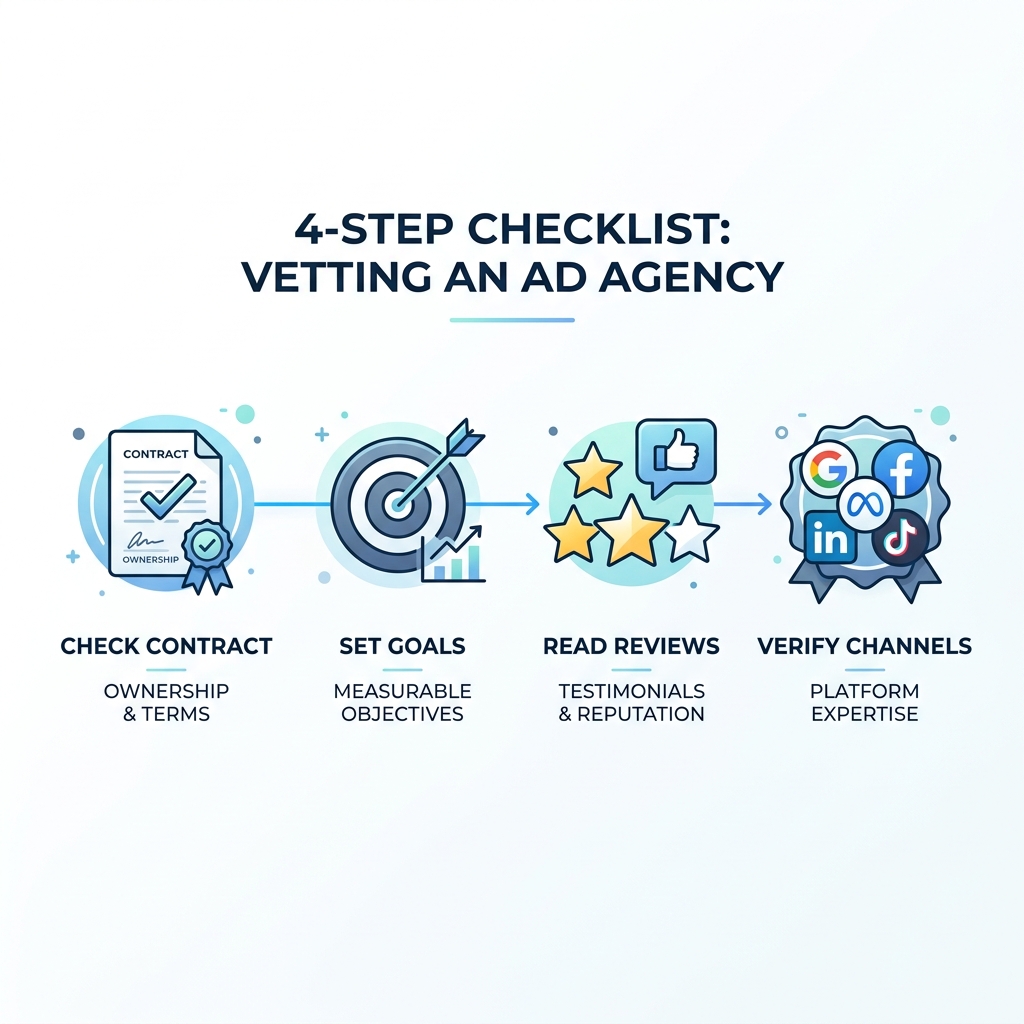
Account Ownership
Confirm in writing that you own the ad accounts and will retain full access — including all historical data — if the relationship ends. This should be a non-negotiable term in any contract. If an agency hesitates on this, that hesitation is your answer.
How They Define Success Before You Sign
Any agency worth hiring should be able to tell you, before you sign: what metrics they'll optimize toward, what a realistic improvement timeline looks like at your budget level, and what they'd consider a successful first 90 days. If the answer is vague — "we'll see how the campaigns perform and adjust" — push harder. A real methodology has specifics attached to it.
Third-Party Reviews vs. Agency-Controlled Testimonials
Testimonials on an agency's own site are curated. Start your reference check with independent platforms like Clutch or Google Reviews, where reviews are harder to filter. Look for patterns across multiple reviewers — not just the star rating, but what clients say about communication, reporting transparency, and how disputes were handled.
Channel-Specific Experience
Ask for case studies in your vertical and on your specific channel. A strong Google Ads team is not the same as a strong Meta Ads team. "We helped a B2B SaaS client reduce CPL by 40% on LinkedIn" is interesting but mostly irrelevant if you're an ecommerce brand trying to improve Google Shopping performance. Specificity is the signal.
Compensation Model and Incentive Alignment
This is a structural question, not just a cost question. When an agency charges a percentage of ad spend — typically 10–20% — their monthly revenue increases when your budget increases. That incentive doesn't always align with your interest in efficient returns. A flat-fee model keeps the agency's income stable regardless of budget changes, which removes the push-spend incentive.
Illustration: Two agencies managing the same $10,000/month Google Ads budget. Agency A charges 15% of spend ($1,500/month). Agency B charges a flat $1,200/month. You ask both whether you should increase budget to $15,000. Agency A earns an additional $750/month if you do. Agency B's income doesn't change. That's not a small difference in incentive structure — it's a meaningful one.
Contract Length and Exit Terms
An agency confident in their work should not need a 12-month contract to retain clients. Month-to-month arrangements — or short-term agreements with clear exit terms — are a real signal that an agency is willing to be held accountable on results rather than on contractual obligation. If the answer is "we require a minimum 12-month commitment," ask what performance benchmarks are built into that commitment and what the exit clause looks like if those benchmarks aren't met.
Pre-Signing Checklist: Questions to Ask Every Marketing Company
Before you sign with any marketing company, get clear, specific answers to these questions:
- [ ] Do I own my ad accounts? Will I have full admin access and retain all account history if we end the relationship?
- [ ] How do you define success for my specific goal, channel, and budget — and what does that look like in the first 90 days?
- [ ] Can you share case studies from clients in my vertical, running the same channel I'm planning to use?
- [ ] How is reporting structured? What decisions should I be able to make after reading my monthly report?
- [ ] How do you charge — flat fee, percentage of ad spend, or another model — and why?
- [ ] What is your client retention rate, and can I speak with a current or recent client?
- [ ] What are the minimum ad spend requirements, and what is the total monthly cost of engagement (management fee plus estimated ad spend)?
- [ ] What is the contract length, and what are the exit terms if results don't materialize?
- [ ] What does your onboarding process look like — do you audit existing accounts before making recommendations?
What Marketing Company Ad Management Should Cost — And What Drives the Price
Most agencies don't publish pricing, and that's not an accident. Walking into a pricing conversation without any framework puts you at a disadvantage. Here's enough orientation to self-qualify before you start talking to anyone.
Common Pricing Models
Retainer (flat monthly fee): A fixed management fee regardless of ad spend volume. Creates stable, predictable costs for the client and removes budget-inflation incentives for the agency.
Percentage of ad spend: Agency fees scale with your monthly budget — typically 10–20%. Simple to calculate, but structurally creates an incentive to grow spend. This is the most common model at mid-size and larger agencies.
Flat fee per channel: A fixed fee per platform managed. Useful when scope is clearly defined and unlikely to shift.
Performance-based: Agency earns based on results — leads generated, revenue attributed. Rare in practice; more common as a hybrid component of a larger retainer. Be cautious: performance-based arrangements require clear, agreed measurement that both parties trust.
What the Pricing Model Means Beyond the Dollar Amount
When an agency earns a percentage of ad spend, scaling your budget from $10,000 to $15,000/month is, financially, in their interest — whether or not that additional $5,000 in spend produces proportionally better results. That's not necessarily bad behavior; it's a structural incentive that a thoughtful buyer should understand before signing.
A flat-fee model works differently: the agency's income is stable across budget changes, so their motivation to recommend a budget increase should be grounded in performance data, not revenue opportunity.
Directional Cost Reference
| Agency Type | Typical Management Fee | Typical Minimum Ad Spend | Notes |
|---|---|---|---|
| Freelancer / Solo Contractor | $500–$1,500 / month | Often $1,000–$3,000 / month | Direct access, limited capacity; variability is high |
| Boutique Performance Agency | $1,500–$3,500 / month | Often $3,000–$5,000 / month | Specialist depth on 1–2 channels; less creative support |
| Mid-Size Agency (performance or full-service) | $3,500–$7,500 / month | Often $5,000–$10,000+ / month | Broader capability; team depth; longer onboarding cycles |
| Large or Full-Service Agency | $7,500+ / month | Often $10,000–$20,000+ / month | Enterprise capability; significant overhead in fee structure |
These are market estimates for directional orientation only. Actual pricing varies significantly by agency, scope, and geography. Always get a written scope-of-work before comparing fees.
A $500/month management fee typically implies a limited engagement — limited time, limited channel depth, limited optimization frequency. A $3,500/month retainer should imply a more intensive engagement with clear deliverables. Neither is inherently right or wrong; the question is whether the price aligns with the scope and your actual goals.
Red Flags to Watch For in Agency Proposals and Pitches
The following aren't edge cases — they show up regularly in agency proposals. Recognizing them isn't cynicism; it's due diligence.
Vague Success Guarantees
"We guarantee results." Ask immediately: what result? By when? Measured how? A credible agency can answer all three clearly. If the follow-up is vague — "we guarantee you'll see improvement" — that's not a guarantee, it's a sales phrase. A guaranteed ROAS or guaranteed top-3 ranking that doesn't come with a written definition, a timeline, and a clear explanation of the variables the agency controls (and doesn't control) should be treated as a red flag, not a selling point.
Agencies That Retain Account Ownership
If an agency says the account will be built and managed under their Google Ads manager account, and they won't commit in writing to transferring access if the relationship ends — stop. This is the clearest structural red flag in agency relationships. Your account history, conversion data, and audience signals have real monetary value. Leaving them behind when you switch agencies means starting over.
Projected Results Without a Baseline Audit
No credible agency can project meaningful results without reviewing your current account structure, existing performance data, and competitive landscape first. If an agency is promising "we'll double your leads in 60 days" in the first pitch meeting — before they've looked at anything — that confidence is not a good sign. It's a sales tactic.
Long Lock-In Contracts Without Performance Benchmarks
A 12-month contract with no defined performance milestones and no meaningful exit clause is structured to protect the agency, not the client. If an agency is asking for a long commitment, ask what happens if agreed benchmarks aren't met at month three or six. If there's no good answer, the contract length is a risk signal.
Vague or Unverifiable Case Studies
"We helped a client triple their revenue." Which client? What channel? What was the baseline? What was the budget? Legitimate case studies have specifics. Vague attribution claims — especially without industry context or channel relevance to your situation — are not evidence of expertise.
Agency Proposal Red Flag Checklist
- [ ] Success is "guaranteed" but without defined metrics, timeline, or measurement method
- [ ] Account will be managed under the agency's account; ownership transfer on exit is unclear or denied
- [ ] Specific result projections offered before any audit of your current account or campaigns
- [ ] Contract requires 12+ months with no defined performance benchmarks or exit clause
- [ ] Case studies lack client industry context, specific channels, or measurable outcomes
- [ ] Agency references all come from their own website rather than independent platforms
- [ ] Compensation is percentage-of-spend with no discussion of how budget increase recommendations are handled
- [ ] Reporting is described as frequent or comprehensive without any explanation of what decisions the reports will support
What to Realistically Expect in the First 90 Days
Results take time. That's a real thing, not just an agency excuse — but there's an important distinction between results taking time and confusion about results lasting indefinitely. A good agency can always explain what they're doing, why, and what success looks like at each stage. If they can't, the problem is accountability, not the algorithm.
The Learning Phase Is Real
Most ad platforms — Google Ads in particular — have a learning phase of roughly two to four weeks when a new campaign launches or is significantly restructured. During this period, the algorithm is optimizing delivery based on early performance signals. Expecting week-one results to represent steady-state performance sets up an unfair comparison. Expecting no explanation of what's happening during that period — or no baseline to compare against — is a reasonable expectation that should be met.
30/60/90-Day Milestone Timeline
| Phase | What Should Happen | What You Should Be Able to See |
|---|---|---|
| Month 1 (Days 1–30) | Account audit, campaign setup or restructure, conversion tracking verification, baseline benchmarking | A written account of what was inherited, what was changed, and why — plus initial performance data against baseline |
| Month 2 (Days 31–60) | Active optimization cycle begins: bid adjustments, audience refinement, negative keyword expansion, early creative testing | Directional improvement trends; clear explanation of what's being tested and why; any tracking or data issues surfaced |
| Month 3 (Days 61–90) | Continued optimization; early performance conclusions from A/B tests; budget allocation review | Measurable movement on primary KPIs (ROAS, CPA, lead volume, CTR); a clear statement of what's working, what isn't, and what comes next |
What Metrics to Track — By Channel
For ecommerce campaigns: ROAS, CPA, conversion rate, revenue attributed to paid channels, and new-customer acquisition rate.
For lead-generation campaigns: cost per lead (CPL), lead volume, lead quality signals (if your CRM tracks downstream conversion), and form completion rate.
Industry benchmark data from WordStream provides useful reference ranges for average ROAS and CPA by industry — helpful context for setting realistic expectations before you start any agency engagement, rather than accepting an agency's projections at face value.
Before the engagement starts, agree in writing on which metrics matter, what baseline you're measuring from, and what meaningful improvement looks like at your budget level. If that conversation is hard to have before signing, imagine how hard it will be three months in.
When to Stay vs. When to Switch
If by the end of month three you cannot get a clear explanation of what's been optimized, what was changed and why, and what the next 30 days of work looks like — that's a performance problem. Not a learning phase. A genuine learning curve produces explainable decisions and measurable directional data. Indefinite learning-phase language without supporting evidence is a different thing entirely.
If you want to pressure-test whether paid search is even the right channel for your business before committing to an agency evaluation, this overview of when PPC is likely to work is a useful starting point.
A marketing company managing your ads handles campaign setup and structure, bid strategy, keyword and audience refinement, negative keyword maintenance, budget pacing, A/B test coordination, and performance reporting. Active management means ongoing, recurring optimization work — not just launching campaigns and monitoring dashboards.
In practice, the terms are often used interchangeably for businesses that manage paid ad campaigns. The meaningful distinction is between agency types — full-service, performance/paid-media specialist, creative boutique — rather than between the labels marketing company and advertising agency. What matters is the specific services in scope, the channels they specialize in, and how they measure results.
Management fees vary significantly by agency type and scope. Freelancers and solo contractors typically charge $500–$1,500/month; boutique performance agencies typically charge $1,500–$3,500/month; mid-size agencies typically charge $3,500–$7,500/month or more. Most agencies also require a minimum monthly ad spend separate from their management fee. The pricing model — flat fee vs. percentage of spend — matters as much as the dollar amount, because it affects the agency's incentives.
You should — but not all agencies structure it that way. Your ad account should be created under your own Google account with the agency given access as a manager, not the reverse. If the relationship ends, you should retain full access to the account, including all campaign history, audience data, and conversion history. Confirm this in writing before signing anything.
Most ad platforms have a learning phase of two to four weeks when new campaigns launch. Directional improvement typically becomes visible in weeks four through eight, with more meaningful optimization outcomes by the end of month three. Results depend heavily on budget, channel, competitive landscape, and starting point. Any agency projecting specific outcomes before auditing your current situation is making promises they can't reasonably support.
Ignore self-reported credentials and look for independently verifiable signals: reviews on third-party platforms like Clutch or Google Reviews, channel-specific case studies with measurable outcomes in your vertical, and the clarity and specificity of their answers to structural questions (account ownership, reporting, contract terms). An agency that handles due-diligence questions directly and without deflection is demonstrating accountability before you've even signed.
It depends on your goals, budget, and internal capacity. In-house management gives you direct control and eliminates management fees, but requires real platform expertise and ongoing time investment. Agency management provides specialist depth and team redundancy, but adds cost and requires clear accountability structures. The freelancer/in-house hybrid is a middle path with genuine tradeoffs. There's no universally right answer — the right choice depends on what your team can realistically execute and what level of oversight you can provide. —
Start With a Low-Risk Evaluation
If you're actively evaluating marketing companies right now, the decision doesn't have to feel like a gamble.
The criteria in this article — account ownership, compensation model, contract flexibility, reporting clarity — give you a framework to compare agencies on substance rather than surface signals. Most buyers don't use this framework because most agencies don't encourage it. That's worth paying attention to.
For businesses evaluating Google Ads specifically, Tailored Marketing offers a flat-fee management model with no setup fees, month-to-month terms, and a first-month refund — not because those are unusual features, but because they reflect what an agency that's confident in its work should be willing to offer.
If you'd like a second opinion on your current campaigns — or want to understand what a real audit of your account would surface before committing to any agency — a no-pressure consult is a practical first step. It's a conversation, not a commitment.
Leave a Reply